All birds Thrushes and Allies
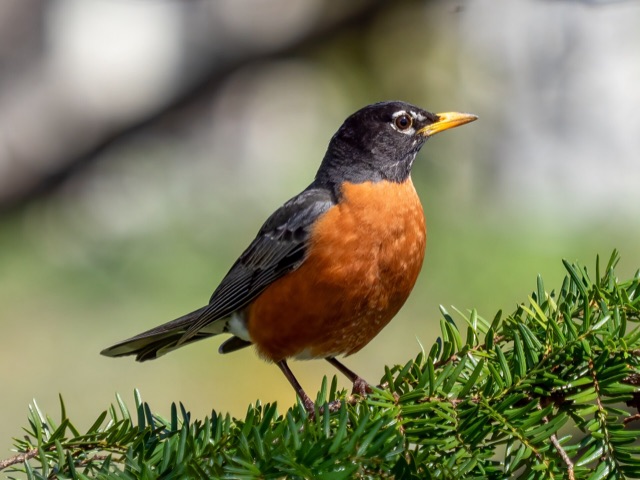

American Robin
Turdus migratorius
Here most of the year.
Recorded by Sean Cozart. CC BY-NC, via iNaturalist, trimmed and volume evened out.
Look for
- An orange-red chest and belly, with a gray-brown back.
- A broken white ring around each eye, and a white chin with dark streaks.
- Males have a darker head, almost black. Females look a little paler.
A little about it
You can find robins here in every season. They're easiest to spot in February and March. From August to November, you'll see far fewer.
Robins eat bugs, earthworms, and fruit. A robin runs a few steps on the lawn, stops, and looks. It finds worms with its eyes. In winter it eats lots of berries.
In fall and winter, robins often travel in flocks. A flock can have 50 birds, or even hundreds.
The nest is a cup of grass and twigs with a base of mud. It may sit on a tree branch or in a gutter. Some robins even build on top of an outdoor light. The female lays 3 to 5 blue eggs. They hatch in about 2 weeks, and the chicks leave the nest about 2 weeks after that.
Fun fact
Robins are some of the first birds to sing in the morning. In spring, a robin often starts while it's still dark outside. Its song sounds like "cheer-up, cheerily."
When it's here
- January: here
- February: here
- March: here
- April: here
- May: here
- June: here
- July: here
- August: here
- September: here
- October: here
- November: here
- December: here
Taller bars mean more sightings. Most often seen in March.
How big
8 to 11 inches. This is the robin! Other birds on this site get compared to it.
Where to look
Lawns and yards with trees nearby. Watch for one running and hopping across the grass. In winter, look in trees and bushes full of berries.
People have spotted it at Myriad Botanical Gardens, Mitch Park, Martin Park Nature Center.
Could it be something else?
Eastern Towhee
Its lower chest and belly are white, and its bill is short and shaped like an ice cream cone. A robin is orange-red all the way down its belly. Tell a Spotted Towhee from a robin the same way.
Young American Robin
Young robins have lots of dark spots on the chest and a blotchy back. Look for a little orange-red on the chest.
Where these facts come from
- Oklahoma Department of Wildlife Conservation field guide
- Audubon Guide to North American Birds
- When it's here: Sightings shared on iNaturalist in the 8 counties, all years.