All birds Swallows
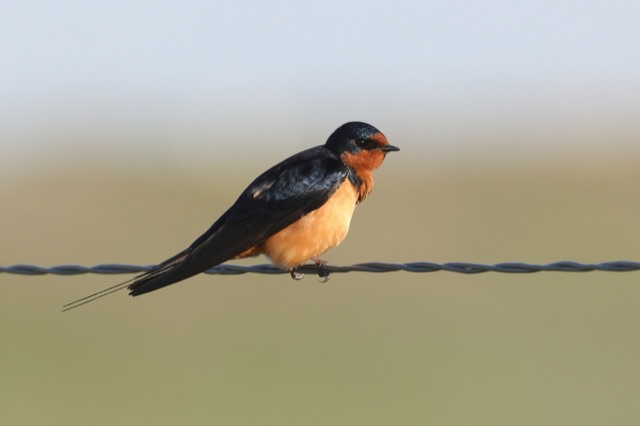

Barn Swallow
Hirundo rustica
Here April to August.
Recorded by Jonathon Jongsma. CC BY-SA 4.0, via xeno-canto, trimmed and volume evened out.
Look for
- A shiny, steel-blue back.
- A rusty orange-brown throat. The chest and belly can be anywhere from orange-tan to white.
- A long tail that splits into 2 points. Young birds have shorter tails.
A little about it
Barn swallows come here for the summer. They're back by April, and June is the best month to see them. By mid-August, many are already heading south.
They catch most of their food in the air. They eat lots of flies, even house flies and horse flies. They also eat beetles, wasps, and flying ants. In bad weather, they may look for food on the ground.
Mom and dad build a cup nest out of mud and dried grass, and line it with feathers. They put it in places like barns and under bridges. The female lays 4 or 5 eggs. Sometimes older brothers and sisters from an earlier nest help feed the babies.
Barn swallows live in Europe and Asia too. They travel in flocks, mostly in the daytime. For the winter, some fly as far as South America or southern Africa.
Fun fact
Long ago, barn swallows built their nests in cracks in cliffs and in shallow caves. Now almost every barn swallow nest is on something people built.
When it's here
- January: not here
- February: not here
- March: a few
- April: here
- May: here
- June: here
- July: here
- August: here
- September: a few
- October: a few
- November: not here
- December: not here
Taller bars mean more sightings. Most often seen in June.
How big
5¾ to 7¾ inches. A little longer than a sparrow, with long, pointed wings.
Where to look
Open land, mostly near water, like farms, fields, ponds, and lakes. Look for them skimming low over a field or a pond.
People have spotted it at Mitch Park, Lake Overholser, Lake Hefner.
Could it be something else?
Eastern Bluebird
The male is blue on top with a reddish-brown throat too. But that color covers his whole chest, and his tail has no long points.
Scissor-tailed Flycatcher
It also has a long tail that splits in 2. But it's pale gray and pink, with no blue, and it's much bigger.
Where these facts come from
- Audubon Guide to North American Birds
- When it's here: Sightings shared on iNaturalist in the 8 counties, all years.