All birds Cardinals and Allies
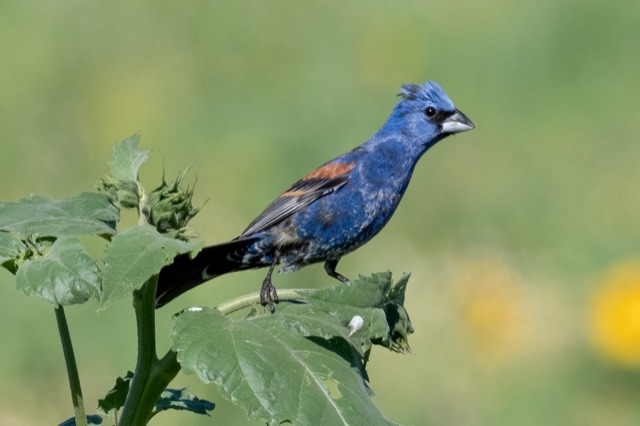
Blue Grosbeak
Passerina caerulea
Here April to August.
Recorded by Chris Harrison. CC BY-NC-SA 3.0, via xeno-canto, trimmed and volume evened out.
Look for
- Males are very dark blue, with a big, thick bill.
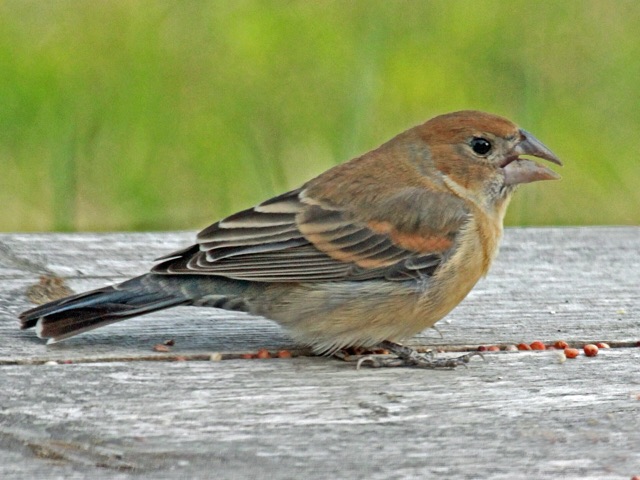
- Wide, rusty-tan stripes across the wings. Males and females both have them.
- Females are warm brown, with the same thick bill.
A little about it
Blue grosbeaks come here for the summer. Look for them from April to August. July has the most. They spend the winter in the tropics.
They eat lots of bugs, like grasshoppers, beetles, cicadas, and even praying mantises. They also eat spiders and snails, plus lots of seeds from weeds and grass.
A blue grosbeak finds most of its food on the ground. It may also hover to grab a bug off a leaf. When it sits on a branch, it often flicks and spreads its tail, like it's nervous.
The male sings to guard his space. The female builds a cup nest low in a bush or vine, usually 3 to 10 feet up. She lays 3 to 5 pale blue eggs, and the babies leave the nest about 9 or 10 days after they hatch.
Fun fact
The female often adds odd things to her nest. She may tuck in a piece of snakeskin, paper, string, or rags.
When it's here
- January: not here
- February: not here
- March: not here
- April: here
- May: here
- June: here
- July: here
- August: here
- September: a few
- October: not here
- November: not here
- December: not here
Taller bars mean more sightings. Most often seen in July.
How big
6 to 7½ inches. A little bigger than a sparrow.
Where to look
Brushy fields and thick bushes along roads and creeks. It often hides in the bushes, but sometimes it sits up in the open.
People have spotted it at Lake Stanley Draper.
Could it be something else?
Indigo Bunting
The male is dark blue too, but he's smaller and slimmer, with a smaller bill. He has no clear wing stripes. A female Indigo Bunting has faint streaks on her chest.
Eastern Bluebird
The male is blue on top, but he has an orange-brown chest and a white belly. A male Blue Grosbeak is dark blue underneath too.
More photos
Where these facts come from
- Audubon Guide to North American Birds
- When it's here: Sightings shared on iNaturalist in the 8 counties, all years.