All birds Crows, Jays, and Magpies
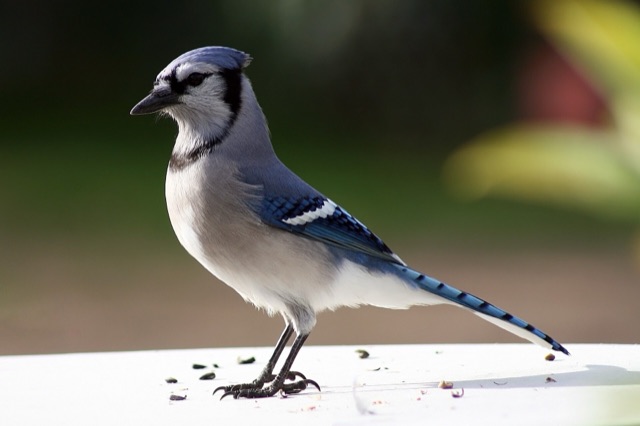

Blue Jay
Cyanocitta cristata
Here all year.
Recorded by Don Bright. CC BY, via iNaturalist, trimmed and volume evened out.
Look for
- Blue on top, with a blue crest on its head.
- A white face and a pale gray belly. A black band goes across the neck like a necklace.
- White bars on the wings. The long tail has thin black stripes and white corners.
A little about it
Blue jays live here all year. Males and females look the same. Listen for their loud "jay! jay!" call.
At feeders, they eat peanuts and black-oil sunflower seeds. Out in the woods, they eat acorns, berries, and bugs. Most of their food comes from plants.
A blue jay holds a seed down with its feet and hammers the shell open with its bill. It may grab a few seeds at once and hide them around the neighborhood for later. It also buries acorns in holes in the ground.
Both parents build the nest in a tree, most often 8 to 30 feet up. It's a big cup of twigs, and they sometimes add bits of paper or string. The female lays 4 or 5 eggs. The young leave the nest about 17 to 21 days after they hatch.
Fun fact
A blue jay can copy the scream of a Red-shouldered Hawk. It sounds almost the same as the real hawk.
When it's here
- January: here
- February: here
- March: here
- April: here
- May: here
- June: here
- July: here
- August: here
- September: here
- October: here
- November: here
- December: here
Taller bars mean more sightings. Most often seen in June.
How big
10 to 12 inches. A little bigger than a robin.
Where to look
Woods with oak trees, and neighborhoods and parks with big, old trees. Blue jays come to feeders too.
People have spotted it at Lake Thunderbird State Park, Mitch Park, Myriad Botanical Gardens.
Could it be something else?
Eastern Bluebird
Also blue, but it's smaller, with a shorter tail and no crest. A bluebird has a red-orange chest.
Where these facts come from
- Oklahoma Department of Wildlife Conservation field guide
- Audubon Guide to North American Birds
- When it's here: Sightings shared on iNaturalist in the 8 counties, all years.