All birds Ducks, Geese, and Waterfowl
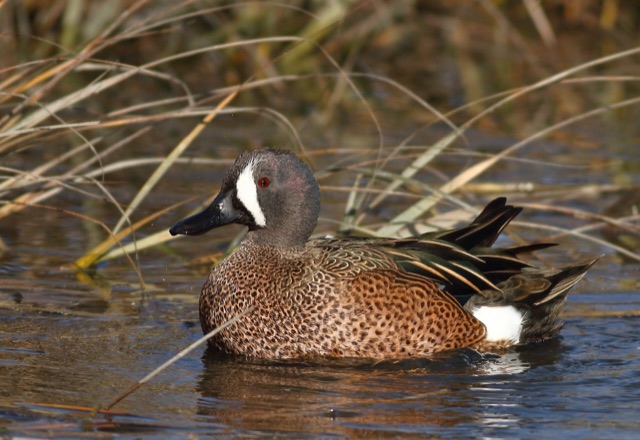

Blue-winged Teal
Spatula discors
Passes through in March to April and again in September to October.
Recorded by Andrew Spencer. CC BY-NC-SA 3.0, via xeno-canto, trimmed and volume evened out.
Look for
- A small duck. In spring, the male has a white crescent on his gray face, like a thin moon.
- A pale blue patch on each wing. It's mostly hidden when the duck swims, but it shows up when it flies.
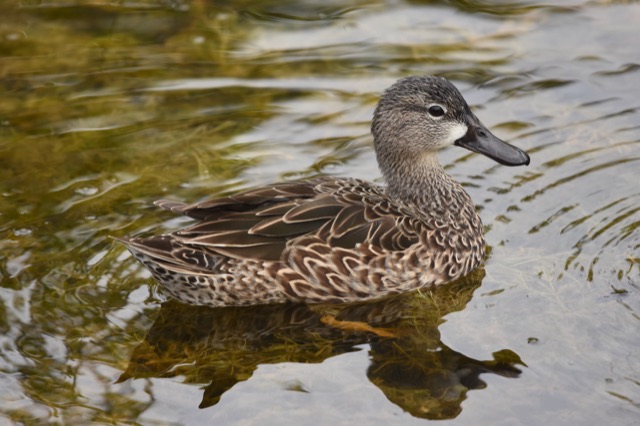
- In fall, many males look plain, a lot like the females.
A little about it
Blue-winged Teal pass through here. Look for them in March and April, and again in September and October. April has the most.
This duck likes warm weather. Many spend the winter as far south as South America. Some fly over the open ocean to get there. They come north later in spring than most ducks, and they head south earlier in fall.
Teal feed in very shallow water. They pick food off the top or swim with their heads partly under. They eat mostly seeds from grasses and water plants. Snails and bugs are on the menu too.
Teal are fast fliers, and a flock twists and turns together in the air. The nest is a dip in the ground, hidden in grass. The mother lays 9 to 13 eggs. The babies leave the nest within a day of hatching, and they find their own food.
Fun fact
In fall, some flocks are made up of only young teal. They've never made the trip before, but they still know the way south.
When it's here
- January: not here
- February: a few
- March: here
- April: here
- May: a few
- June: a few
- July: not here
- August: a few
- September: here
- October: here
- November: a few
- December: a few
Taller bars mean more sightings. Most often seen in April.
How big
About 16 inches. A little smaller than a crow.
Where to look
Shallow ponds and marshes. Small groups like to stand on stumps or rocks at the edge of the water.
People have spotted it at Martin Park Nature Center, Stinchcomb Wildlife Refuge, Lake Hefner.
Could it be something else?
Northern Shoveler
A shoveler has a blue wing patch too. But it's bigger, and its bill is huge and shaped like a spoon. A teal has a small bill.
More photos
Where these facts come from
- Audubon Guide to North American Birds
- When it's here: Sightings shared on iNaturalist in the 8 counties, all years.