All birds Wrens
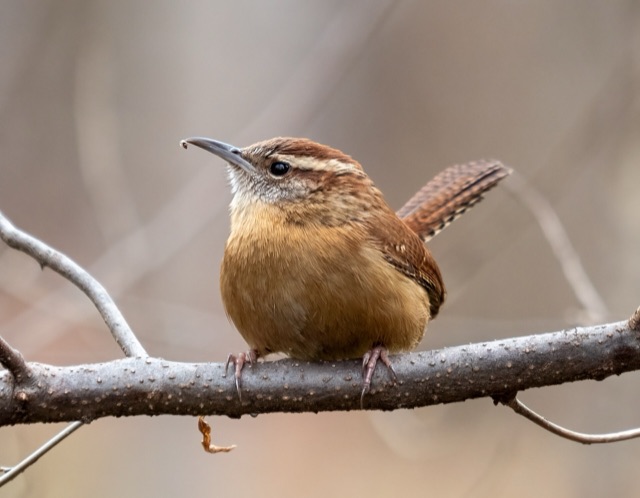

Carolina Wren
Thryothorus ludovicianus
Here all year.
Recorded by Patricia H. CC BY-NC, via iNaturalist, trimmed and volume evened out.
Look for
- Warm reddish brown on top, with a cinnamon orange belly.
- A bold white stripe over each eye and a long, thin bill.
- A short tail that it often holds straight up.
A little about it
Carolina Wrens live here all year. A pair stays together in every season, and they may mate for life.
It has a loud, whistled song. Listen for "tea-kettle, tea-kettle, tea-kettle." It sings all day long, all year. Sometimes the female chatters along while the male sings, like a duet.
Wrens hop through leaves and bushes hunting bugs and spiders. Now and then they catch a small lizard or a tree frog. They even eat poison ivy berries. At feeders, they like suet and even chopped apples.
A wren will nest in almost any hole or nook. It might pick a hollow tree, a nest box, or even a shelf in a garage. The nest is often a ball with a door on the side. The babies leave the nest 12 to 14 days after they hatch.
Fun fact
Carolina Wrens often tuck a piece of old snakeskin into their nests.
When it's here
- January: here
- February: here
- March: here
- April: here
- May: here
- June: here
- July: here
- August: here
- September: here
- October: here
- November: here
- December: here
Taller bars mean more sightings. Most often seen in October.
How big
About 5 inches. A little smaller than a sparrow.
Where to look
Thick, tangled bushes and brush piles in woods and yards. Look low, near the ground.
People have spotted it at Martin Park Nature Center, Mitch Park, Oklahoma City Zoo area.
Could it be something else?
Bewick's Wren
It has a white eyebrow too, but it's duller brown on top and pale gray below. Its tail is longer, with white spots at the corners.
House Wren
It's plainer gray-brown, with only a faint line over the eye. A Carolina Wren is warmer brown and has a bold white eyebrow.
Where these facts come from
- Oklahoma Department of Wildlife Conservation field guide
- Audubon Guide to North American Birds
- When it's here: Sightings shared on iNaturalist in the 8 counties, all years.