All birds Hawks, Eagles, and Kites
Cooper's Hawk
Astur cooperii
Here most of the year.
Recorded by Andrew Spencer. CC BY-NC-SA 3.0, via xeno-canto, trimmed and volume evened out.
Look for
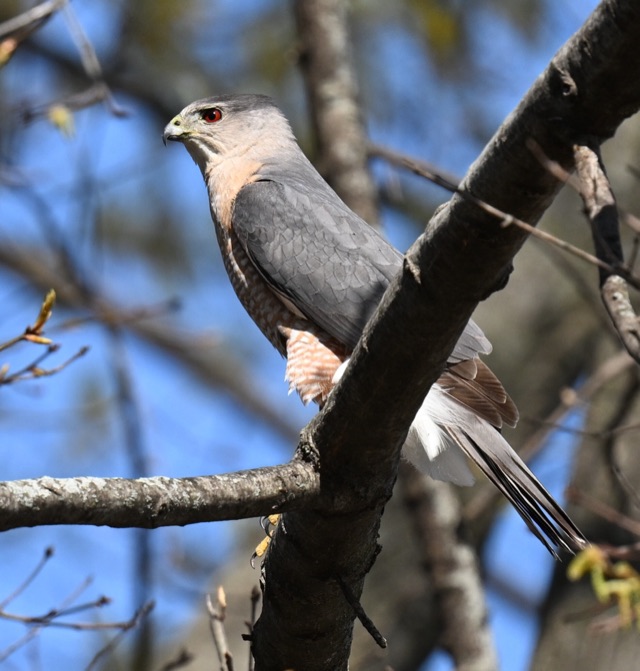
- Blue-gray on the back, with a dark cap on the head.
- A pale, reddish chest and belly.
- A long tail with a rounded tip. The very end of the tail is white.
A little about it
You can see Cooper's Hawks here all year. They're easiest to find in fall, and October has the most. Spring is when you'll see the fewest. Some that nest far to the north fly south for the winter.
This hawk hunts by sneaking. It slips from branch to branch in thick trees and bushes, looking and listening. Then it shoots out fast to grab its prey. Sometimes it flies low behind bushes to take birds by surprise.
It eats mostly birds about the size of a robin or a jay. It also catches chipmunks, squirrels, mice, and even bats.
The nest is a big pile of sticks in a tree, usually 25 to 50 feet up. It's often built on top of an old nest or a squirrel nest. The female lays 3 to 5 pale blue eggs. The young can fly when they're 4 or 5 weeks old.
Fun fact
While the female sits on the eggs, the male brings her food. Then he takes a turn on the eggs for a few minutes while she eats.
When it's here
- January: here
- February: here
- March: here
- April: here
- May: here
- June: here
- July: here
- August: here
- September: here
- October: here
- November: here
- December: here
Taller bars mean more sightings. Most often seen in October.
How big
15 to 18 inches. About as big as a crow. Females are bigger than males.
Where to look
Woods and the edges of woods, and parks and neighborhoods with tall trees. More and more of these hawks now live in towns.
People have spotted it at Mitch Park, Stinchcomb Wildlife Refuge, Lake Hefner.
Could it be something else?
Sharp-shinned Hawk
Same colors, but smaller, with a small head and very thin legs. The end of its tail usually looks square. A big female Sharp-shin can be as big as a male Cooper's Hawk, so check the tail.
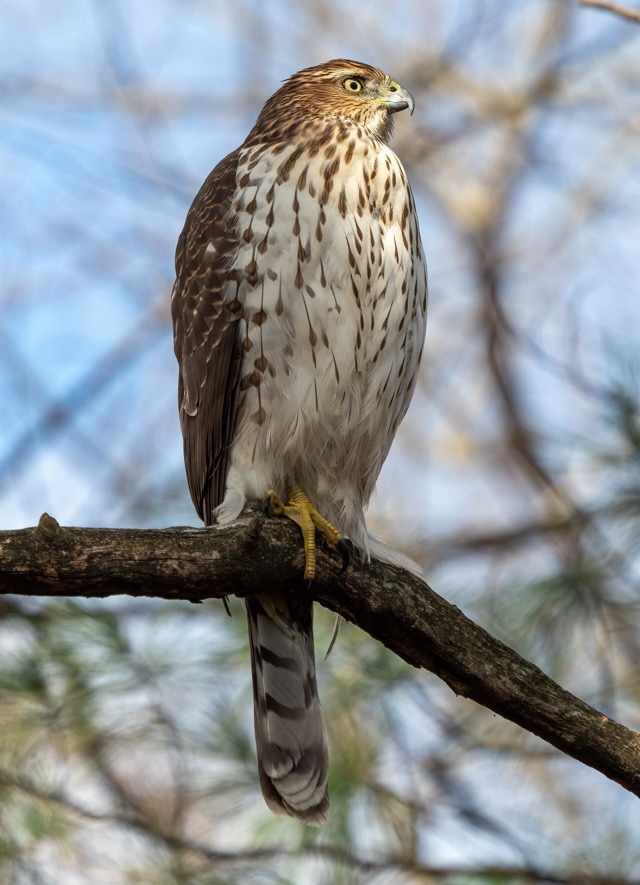
Young Cooper's Hawk
Brown on top instead of gray. Its white chest has sharp, dark stripes.
More photos
Where these facts come from
- Audubon Guide to North American Birds
- When it's here: Sightings shared on iNaturalist in the 8 counties, all years.