All birds Woodpeckers
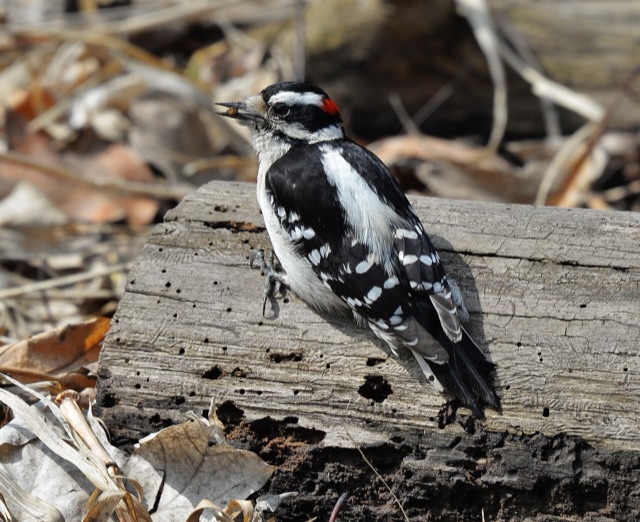

Downy Woodpecker
Dryobates pubescens
Here all year.
Recorded by Nathan Klay. CC BY-NC, via iNaturalist, trimmed and volume evened out.
Look for
- Black and white, with a wide white stripe down the middle of the back.
- A short, stubby bill, only about half as long as its head.
- Males have a small red spot on the back of the head. Females have no red.
A little about it
Downy Woodpeckers stay here all year. They don't migrate.
It eats mostly bugs, especially beetles and ants. It also eats seeds and berries. At feeders, look for it on the suet.
Because it's so small, it can feed on thin twigs and even weed stalks. It often hangs upside down while it hunts. In winter, it joins flocks of chickadees and nuthatches as they move through the woods.
In late winter, males and females drum loudly on dead branches. Then a pair digs a nest hole in a dead tree or branch, usually 12 to 30 feet up. The female lays 4 or 5 white eggs. The young leave the nest 20 to 25 days after they hatch.
Fun fact
This is the smallest woodpecker in North America. A Downy weighs 1 ounce or less.
When it's here
- January: here
- February: here
- March: here
- April: here
- May: here
- June: here
- July: here
- August: here
- September: here
- October: here
- November: here
- December: here
Taller bars mean more sightings. Most often seen in February.
How big
5 to 7 inches. About as big as a sparrow.
Where to look
Any place with trees, from the woods to your backyard. Downies often visit feeders.
People have spotted it at Lake Thunderbird State Park, Martin Park Nature Center, Mitch Park.
Could it be something else?
Hairy Woodpecker
Same black and white pattern, but bigger, nearly the size of a robin. Its bill is about as long as its head. Hairies aren't common in towns here, so a small one at your feeder is most likely a Downy.
Where these facts come from
- Oklahoma Department of Wildlife Conservation field guide
- Audubon Guide to North American Birds
- When it's here: Sightings shared on iNaturalist in the 8 counties, all years.