All birds Gulls, Terns, and Skimmers
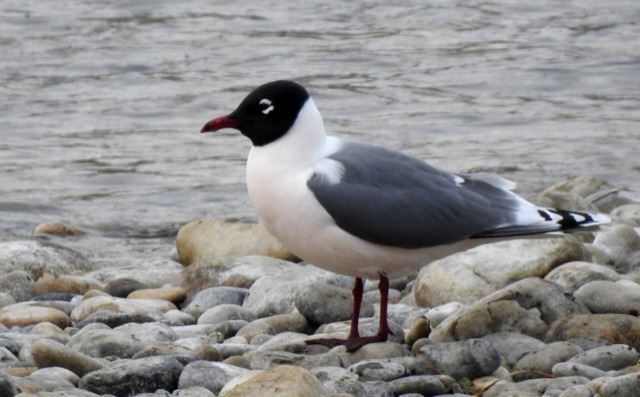

Franklin's Gull
Leucophaeus pipixcan
Passes through in April to May and again in September to November.
Recorded by Paul Marvin. CC BY-NC-SA 4.0, via xeno-canto, trimmed and volume evened out.
Look for
- A small gull with a gray back and a white belly. In spring, grown-ups have a black head and a red bill.
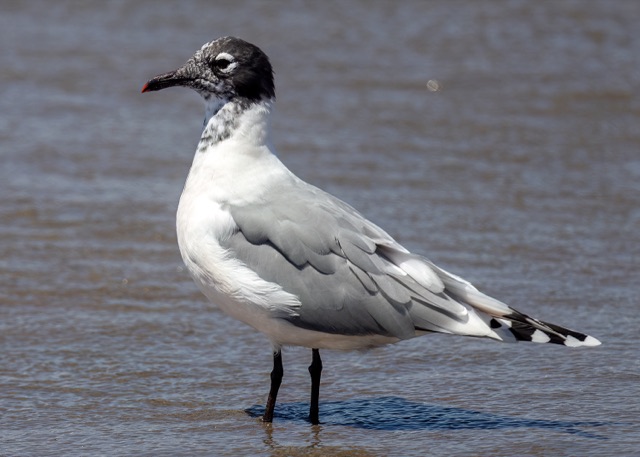
- In fall, young gulls have a mostly white head with a dark patch on the back of it, like a scarf.
- Wingtips that are mostly white, with a black band across them.
A little about it
Franklin's Gulls pass through here. Look for them in April and May, then again from September to November. You'll see the most in October and November.
They nest up north, in marshes on the prairie. In winter, most of them fly all the way to the west coast of South America. Some people call this gull the "Prairie Dove."
In summer, it eats mostly bugs, like grasshoppers, and earthworms. It also eats seeds, leeches, snails, and crayfish. It can catch bugs in the air, or wade and swim to find food.
These gulls nest in big groups, and some groups have thousands of pairs. Both parents feed the chicks, and 1 of them stays with the chicks at all times. The young can fly when they're about 5 weeks old.
Fun fact
A Franklin's Gull nest floats on the water of a marsh. The gulls build it out of cattails and other plants. They steal a lot of those plants from their neighbors' nests!
When it's here
- January: a few
- February: a few
- March: a few
- April: here
- May: here
- June: a few
- July: a few
- August: a few
- September: here
- October: here
- November: here
- December: a few
Taller bars mean more sightings. Most often seen in October.
How big
13 to 15 inches, with wings 2 and a half to 3 feet across. A little smaller than a crow. It's smaller than a Ring-billed Gull too.
Where to look
Lakes, marshes, farm fields, and flooded pastures. Big flocks often follow farmers as they plow their fields.
People have spotted it at Lake Hefner, Stinchcomb Wildlife Refuge, Lake Stanley Draper.
Could it be something else?
Ring-billed Gull
A bigger gull with yellow legs and a yellow bill with a black ring around it. Its wingtips are black, with white spots.
More photos
Where these facts come from
- Audubon Guide to North American Birds
- When it's here: Sightings shared on iNaturalist in the 8 counties, all years.