All birds Owls
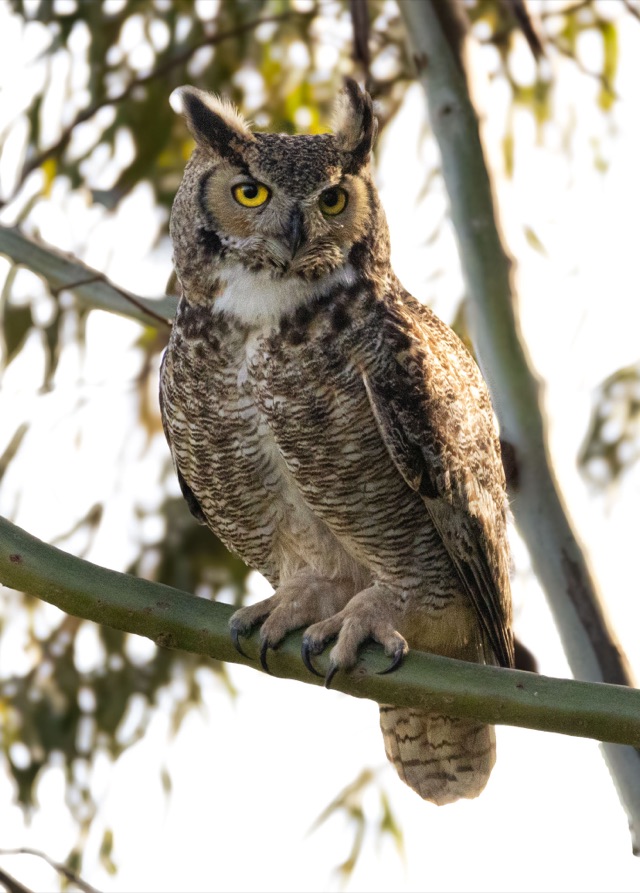
Great Horned Owl
Bubo virginianus
Here all year.
Recorded by Ted Floyd. CC BY-NC-SA 4.0, via xeno-canto, trimmed and volume evened out.
Look for
- 2 big tufts of feathers on top of the head. They look like ears or horns.
- A white patch on the throat.
- Brown and gray all over, with dark bars across the belly.
A little about it
Great Horned Owls live here all year, so you can find them in any month. They don't migrate, but some wander far in fall and winter. Listen for a deep hoot that carries far: hoo, hoo-hoo, hoo, hoo.
This owl hunts mostly at night. It watches from a high perch, then swoops down and grabs its prey with its talons. It hears very well and can see in dim light. It eats lots of rats, mice, and rabbits, and even skunks, snakes, and scorpions. It's so tough that some people call it the "tiger owl."
This owl doesn't build its own nest. It moves into an old nest made by a hawk, crow, or heron, often 20 to 60 feet up. Sometimes it even takes over a Bald Eagle's nest. The young climb out onto branches at about 5 weeks, and they can fly at 9 or 10 weeks.
Fun fact
Far up north in winter, an owl's leftover food can freeze. The owl comes back and sits on it, like it's an egg, to thaw it out.
When it's here
- January: here
- February: here
- March: here
- April: here
- May: here
- June: here
- July: here
- August: here
- September: here
- October: here
- November: here
- December: here
Taller bars mean more sightings. Most often seen in September.
How big
18 to 24 inches, with wings about 4 feet across. Bigger than a crow, and much heavier. Females are bigger than males.
Where to look
Almost anywhere with some trees, from deep woods to parks in town. It's hard to spot in the daytime, so listen for it at dusk and at night.
People have spotted it at Stinchcomb Wildlife Refuge, Martin Park Nature Center, Lake Overholser.
Could it be something else?
Eastern Screech-Owl
It has ear tufts too, but it's only about as big as a robin. It can be gray, reddish, or brown.
Barred Owl
Almost as big, but its head is round with no ear tufts, and its eyes are dark.
Where these facts come from
- Audubon Guide to North American Birds
- When it's here: Sightings shared on iNaturalist in the 8 counties, all years.