All birds Troupials and Allies

Great-tailed Grackle
Quiscalus mexicanus
Here all year.
Recorded by pisum. CC BY-NC, via iNaturalist, trimmed and volume evened out.
Look for
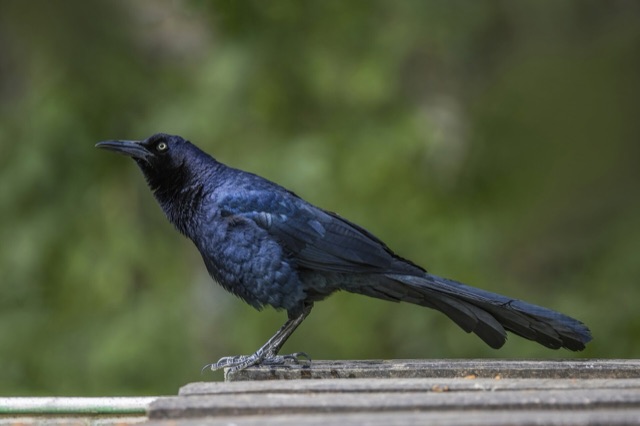
- Males are shiny black with a blue-purple gleam. Their tail is very long and wide.
- Yellow eyes, on both males and females.
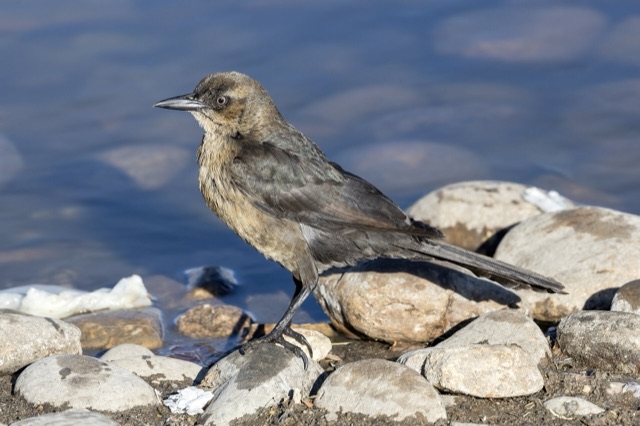
- Females are smaller and brown, with a pale belly and a pale stripe over the eye. Their tail is shorter.
A little about it
You can see grackles here all year, but there are many more from June to October. For many years now, these birds have been spreading north.
Grackles eat almost anything. They catch bugs, snails, crayfish, small fish, and lizards, and they eat seeds and fruit too. At feeders they like cracked corn and sunflower seeds.
They feed in flocks, mostly on the ground. Sometimes big, noisy flocks sleep together in trees in city parks. They have lots of different calls, like whistles and clucks.
Grackles nest in groups, from a few pairs up to hundreds. The female builds a bulky cup of twigs and grass, often with mud at the bottom. She lays 3 or 4 eggs and feeds the babies by herself.
Fun fact
Female grackles sometimes steal twigs and grass from each other's nests.
When it's here
- January: here
- February: here
- March: here
- April: here
- May: here
- June: here
- July: here
- August: here
- September: here
- October: here
- November: here
- December: here
Taller bars mean more sightings. Most often seen in August.
How big
15 to 23 inches. Males are about as long as a crow, with a very long tail. Females are smaller.
Where to look
In town and on farms. Look for them walking on lawns in noisy groups, or wading at the edge of a pond.
People have spotted it at Myriad Botanical Gardens, Oklahoma City Zoo area, Mitch Park.
Could it be something else?
Common Grackle
Much smaller, with a bronze shine on its back and sides. A male Great-tailed Grackle is bigger and black all over.
More photos
Where these facts come from
- Oklahoma Department of Wildlife Conservation field guide
- Audubon Guide to North American Birds
- When it's here: Sightings shared on iNaturalist in the 8 counties, all years.