All birds Sandpipers and Allies
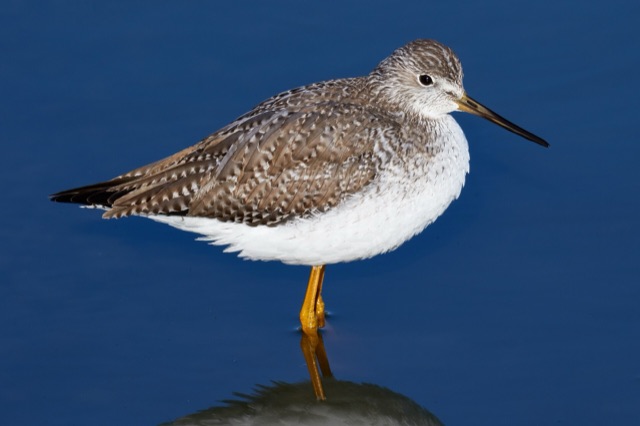

Greater Yellowlegs
Tringa melanoleuca
Here most of the year.
Recorded by Thomas Magarian. CC BY-NC-SA 4.0, via xeno-canto, trimmed and volume evened out.
Look for
- Long yellow legs. That's how it got its name.
- A long bill that's thick near the face. It may look like it bends up a tiny bit.
- A trim wader that runs around in shallow water as it feeds.
A little about it
You can find Greater Yellowlegs here in most months. In June and July they're far up north. They nest in boggy, wet spots in the big northern forests.
It's a busy hunter. Sometimes it runs after little fish called minnows. It may also walk forward and swing its head from side to side, with the tip of its bill in the water. When it's not nesting, it often eats small fish. It also eats bugs, snails, tadpoles, and sometimes berries.
Listen for its loud whistle: "whew-whew-whew." It's the best way to tell it from its smaller cousin, the Lesser Yellowlegs.
The nest is a shallow dip on the ground, hidden in moss. It's often next to a log. There are usually 4 eggs. The chicks find all their own food. If danger comes near, the parents make a loud fuss and may even attack.
Fun fact
When a person walks up, a Greater Yellowlegs bobs its head and calls loudly. Its alarm can scare off the other shorebirds nearby too.
When it's here
- January: here
- February: here
- March: here
- April: here
- May: here
- June: not here
- July: not here
- August: here
- September: here
- October: here
- November: here
- December: here
Taller bars mean more sightings. Most often seen in April.
How big
11 to 15 inches, with wings a little over 2 feet across. A bit bigger than a robin, with long legs.
Where to look
Shallow water at the edges of ponds, lakes, marshes, and creeks. It wades right in to find food.
People have spotted it at Lake Hefner.
Could it be something else?
Lesser Yellowlegs
Looks almost the same, with yellow legs, but it's smaller. It's hard to tell the size unless they stand side by side. The Lesser's bill is shorter and thinner. Its call is a flat "tu-tu," less musical than the Greater's.
Where these facts come from
- Audubon Guide to North American Birds
- When it's here: Sightings shared on iNaturalist in the 8 counties, all years.