All birds Old World Sparrows

House Sparrow
Passer domesticus
Here all year.
Recorded by Misha Zitser. CC BY-NC, via iNaturalist, trimmed and volume evened out.
Look for
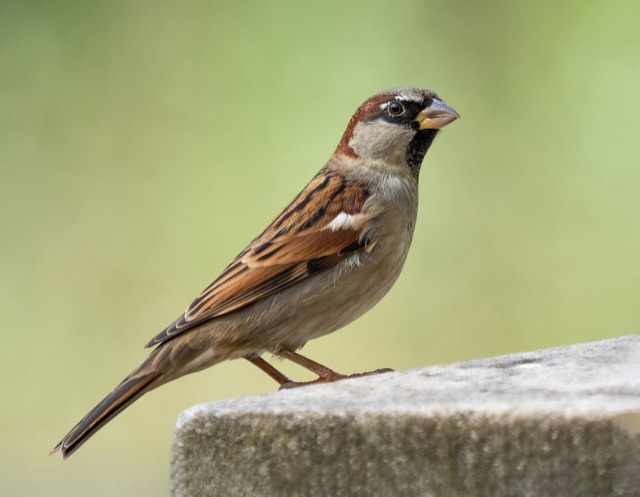
- Males have a black bib on the throat and white cheeks.
- On males, a gray cap with rusty brown on the back of the neck.
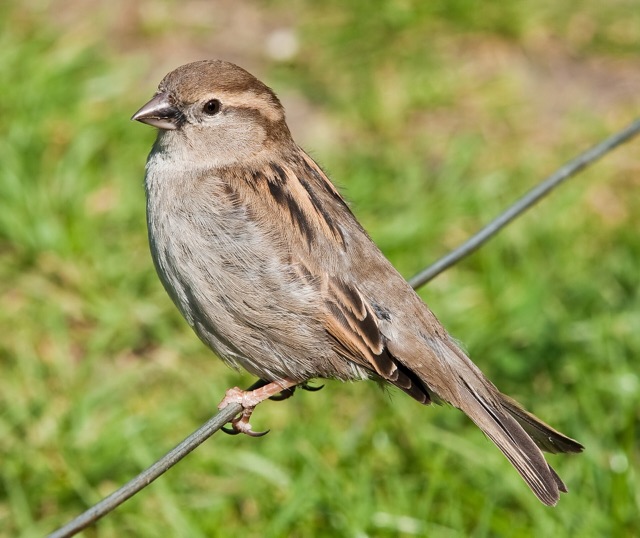
- Females have a plain gray chest, a pale stripe over the eye, and a brown back with black stripes.
A little about it
People brought house sparrows here from Europe, Asia, and North Africa. The first ones were let go in New York in 1851. Now they live all over North America, all year long.
They hop on the ground to look for food, mostly seeds from weeds and grass and leftover grain. In summer they eat some bugs too. In cities, they snack on crumbs people drop.
House sparrows like to nest in holes, such as gaps in buildings, rain gutters, and birdhouses. They even move into other birds' nests. Both parents help build the nest, and the babies leave about 2 weeks after they hatch.
These birds are tough and bossy. In the country, they sometimes push other birds out of their nests. Listen for their loud chirp, chirp, chirp, over and over.
Fun fact
House sparrows find food in odd places. Some have been seen picking squashed bugs off the front of parked cars.
When it's here
- January: here
- February: here
- March: here
- April: here
- May: here
- June: here
- July: here
- August: here
- September: here
- October: here
- November: here
- December: here
Taller bars mean more sightings. Most often seen in June.
How big
5 to 6½ inches. About the same size as a House Finch.
Where to look
Anywhere people have built things. Look in parking lots, on busy sidewalks, in yards, and around farms. They stay close to buildings and almost never live out in the wild.
People have spotted it at Mitch Park, Myriad Botanical Gardens, Lake Overholser.
Could it be something else?
House Finch
A female House Finch has blurry brown streaks all down her front. A female House Sparrow's chest is plain gray with no streaks. A male House Finch has red on his face and chest, and a male House Sparrow has a black bib.
More photos
Where these facts come from
- Audubon Guide to North American Birds
- When it's here: Sightings shared on iNaturalist in the 8 counties, all years.