All birds Plovers and Lapwings
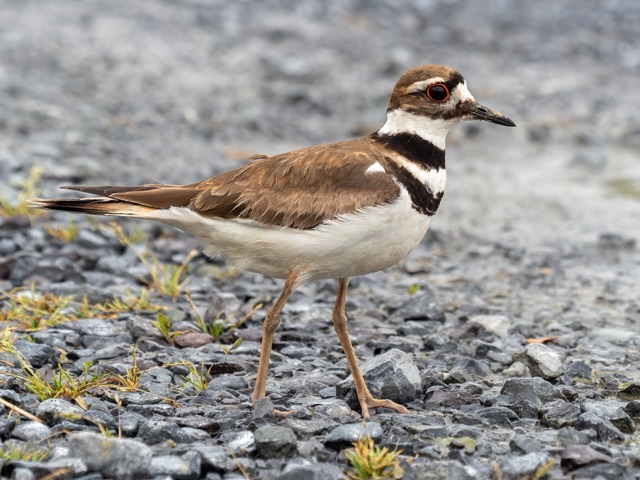

Killdeer
Charadrius vociferus
Here all year.
Recorded by Nick Komar. CC BY-NC-SA 4.0, via xeno-canto, trimmed and volume evened out.
Look for
- 2 black bands across a white chest, like 2 necklaces.
- A brown back and white belly. There's a white patch on the face between its big eyes.
- A bright orange tail. You'll see it best when the bird flies or shows off.
A little about it
You can see killdeer here in every month. There are fewer in the middle of winter. Some killdeer from up north fly to Mexico for the winter. Many that live in the south stay all year.
Killdeer say their own name. Listen for a high, sharp "kill-deee! kill-deee!" as one flies over.
A killdeer runs a few steps, stops, and looks. Then it runs again and pecks when it spots food. It eats mostly bugs, like beetles and grasshoppers. It also eats worms, snails, and even crayfish. Killdeer sometimes follow a farmer's plow to grab the grubs it digs up.
The nest is just a shallow scrape on bare ground or gravel. The eggs have dark spots, so they blend in with the ground. Most of the time there are 4. The fuzzy chicks leave the nest as soon as they're dry and start looking for food with their parents.
Fun fact
If something comes near its nest, a killdeer acts like its wing is broken. It flops on the ground to lead the danger away from its eggs. When the danger gets too close, the killdeer runs off.
When it's here
- January: here
- February: here
- March: here
- April: here
- May: here
- June: here
- July: here
- August: here
- September: here
- October: here
- November: here
- December: here
Taller bars mean more sightings. Most often seen in October.
How big
8 to 11 inches. About as big as a robin.
Where to look
Open ground with short grass or gravel. Killdeer live near ponds and lakes, but also far from water on lawns, ball fields, and gravel parking lots.
People have spotted it at Lake Hefner, Lake Stanley Draper, Arcadia Lake.
Could it be something else?
Semipalmated Plover
Smaller, with just 1 dark band on its chest and orange legs. It stops at muddy lake shores when it's passing through.
Young Killdeer
The fuzzy chicks have long legs like stilts and just 1 black band. They grow their second band when they're about 17 days old.
Where these facts come from
- Oklahoma Department of Wildlife Conservation field guide
- Audubon Guide to North American Birds
- When it's here: Sightings shared on iNaturalist in the 8 counties, all years.