All birds Hawks, Eagles, and Kites
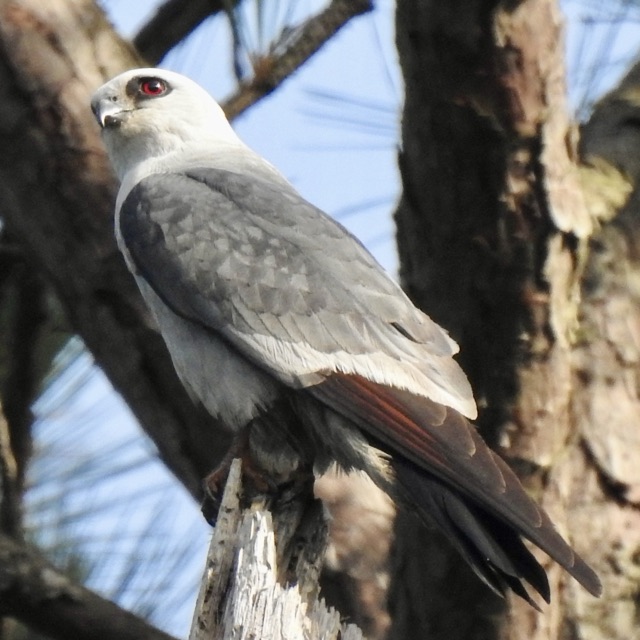
Mississippi Kite
Ictinia mississippiensis
Here May to September.
Recorded by Thomas McDaniel. CC BY-NC, via iNaturalist, trimmed and volume evened out.
Look for
- A gray body with a pale, almost white head.
- A black tail and red eyes.
- Long, pointed wings. It glides and turns in the sky with hardly a flap.
A little about it
Kites spend the summer here. They nest high in big trees, often right in town.
They hunt big bugs in the air, like cicadas, dragonflies, and grasshoppers. A kite grabs a bug with its feet and eats it while it flies.
In late summer, kites gather in groups. Then they fly all the way to South America for the winter. That's a trip of thousands of miles.
If kites have a nest close by, they may swoop down at people who walk too near. If that happens, take a different path for a few weeks. The young kites leave the nest when they are about 5 weeks old. Kites are protected by law, so never bother a nest.
Fun fact
A kite often eats its lunch in midair. It holds a bug in one foot, bends its head down, and takes bites while it glides.
When it's here
- January: not here
- February: a few
- March: a few
- April: a few
- May: here
- June: here
- July: here
- August: here
- September: here
- October: not here
- November: not here
- December: not here
Taller bars mean more sightings. Most often seen in August.
How big
About 14 inches, with wings 3 feet across. A little smaller than a crow, with long, pointed wings.
Where to look
Tall trees in neighborhoods, parks, and golf courses, and the open sky above them. On summer afternoons, look up.
People have spotted it at Lake Stanley Draper, Arcadia Lake, Stinchcomb Wildlife Refuge.
Could it be something else?
Peregrine Falcon
Also gray with pointed wings, but it has a dark hood on its head and fine bars on its belly. It flies with fast, strong wingbeats. A kite has a pale head and floats more.
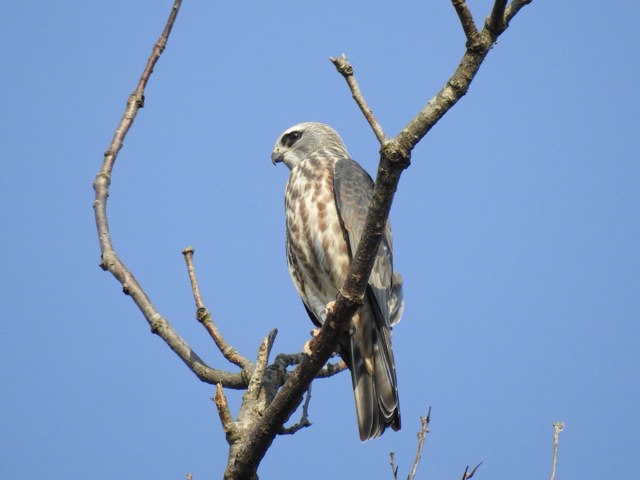
Young Mississippi Kite
In their first summer, young kites are brown with streaks on the chest and stripes on the tail. They still have the kite shape.
More photos
Where these facts come from
- Oklahoma Department of Wildlife Conservation field guide
- Audubon Guide to North American Birds
- When it's here: Sightings shared on iNaturalist in the 8 counties, all years.