All birds Pigeons and Doves
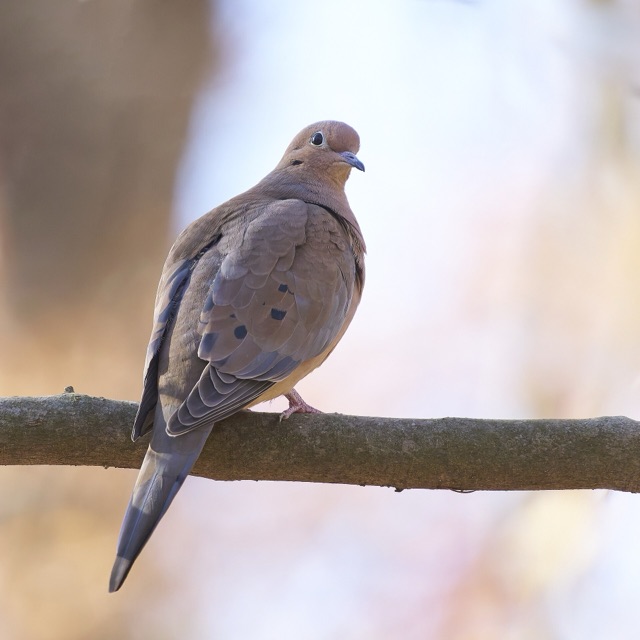

Mourning Dove
Zenaida macroura
Here most of the year.
Recorded by Paul Marvin. CC BY-NC-SA 3.0, via xeno-canto, trimmed and volume evened out.
Look for
- A plump, plain tan bird with a small head and a long, pointed tail.
- Black spots on the wings. When it flies, white spots show along the edges of the tail.
- Males have a pinkish chest and a blue-gray cap. Females are plainer brown.
A little about it
Mourning Doves are here most of the year. In fall, many fly south. The young birds leave first, then the females, and the males go last. Some stay all winter near bird feeders, but there are far fewer around in early winter.
Doves eat seeds, and almost nothing else. They like corn, millet, wheat, sunflower seeds, and lots more. A dove gulps seeds fast to fill up. Then it rests while it digests them.
Its name comes from its low, sad song: "coo-ah, coo, coo, coo." Listen for the wings, too. They make a sharp whistle when a dove takes off or lands. Doves are fast fliers and can hit 55 miles per hour.
The nest is a thin, loose pile of twigs in a tree or bush, or even in a house gutter. The female lays 2 white eggs. Both parents feed the babies a special food called crop milk. In warm places, a pair can raise up to 6 families in 1 year. That's more than any other bird from North America.
Fun fact
If a hungry animal comes near the nest, a parent dove may flop on the ground like it has a hurt wing. The animal follows it away from the nest. Then the dove flies off.
When it's here
- January: here
- February: here
- March: here
- April: here
- May: here
- June: here
- July: here
- August: here
- September: here
- October: here
- November: here
- December: here
Taller bars mean more sightings. Most often seen in July.
How big
9 to 13 inches. About as big as a robin, with a long, pointed tail.
Where to look
Yards and farm fields with a few trees around. Look for doves on power lines and fences, or on the ground under feeders.
People have spotted it at Lake Thunderbird State Park, Martin Park Nature Center, Mitch Park.
Could it be something else?
Eurasian Collared-Dove
A little bigger and paler, with a thin black ring on its neck. It has big white patches on its tail.
White-winged Dove
Bulkier, with a shorter, square tail. When it flies, you'll see big white patches on its wings.
Where these facts come from
- Oklahoma Department of Wildlife Conservation field guide
- Audubon Guide to North American Birds
- When it's here: Sightings shared on iNaturalist in the 8 counties, all years.