All birds Mockingbirds and Thrashers
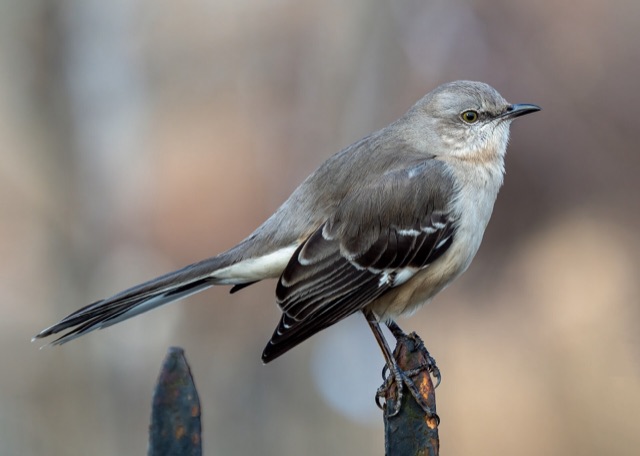

Northern Mockingbird
Mimus polyglottos
Here all year.
Recorded by tim-springer. CC BY-NC, via iNaturalist, trimmed and volume evened out.
Look for
- Gray on top and paler below, with a long, dark tail.
- 2 white bars on each wing. When it flies, a big white patch flashes on each wing.
- White feathers on the outer edges of the tail. Males and females look alike.
A little about it
Mockingbirds live here all year. Each one guards its own space, even in winter. You'll usually see one alone or in a pair.
In a year, about half of what it eats is bugs, and half is berries and fruit. In summer it hunts beetles and grasshoppers on the lawn. It runs a few steps, stops, and opens its wings partway to flash the white patches. In fall and winter it eats mostly berries.
To bring a mockingbird to your yard, put out water. In fall and winter, bushes with fruit help too.
The nest goes in a thick bush or tree, most often 3 to 10 feet up. The male builds most of the twig base, and the female adds a soft lining. The young leave the nest about 12 days after they hatch, but they can't fly well for about another week. Mockingbirds will attack cats, and even people, that get too close to the nest.
Fun fact
A mockingbird copies the songs of other birds. It sings each bit 3 or more times, then moves on to a new one. When it's nesting, it sings all day and often all night too.
When it's here
- January: here
- February: here
- March: here
- April: here
- May: here
- June: here
- July: here
- August: here
- September: here
- October: here
- November: here
- December: here
Taller bars mean more sightings. Most often seen in July.
How big
8 to 10 inches. About the size of a robin, but slimmer, with a long tail.
Where to look
Neighborhoods and farms with thick bushes next to open grass. Mockingbirds are common right in town.
People have spotted it at Oklahoma City Zoo area, Mitch Park, Arcadia Lake.
Could it be something else?
Loggerhead Shrike
Easy to mix up with a mockingbird. Look at the face: a shrike has a black mask. It also has black wings and a thicker black bill.
Young Northern Mockingbird
Young birds have dark streaks on the chest. Their eyes are darker than a grown-up's.
Where these facts come from
- Oklahoma Department of Wildlife Conservation field guide
- Audubon Guide to North American Birds
- When it's here: Sightings shared on iNaturalist in the 8 counties, all years.