All birds Woodpeckers
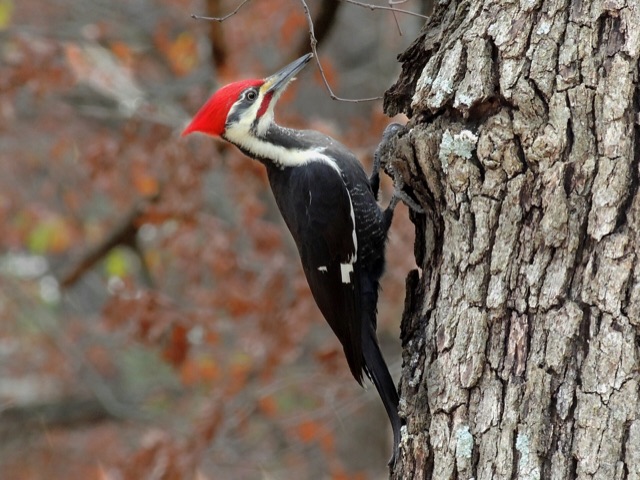

Pileated Woodpecker
Dryocopus pileatus
Here all year.
Recorded by Russ Wigh. CC BY-NC-SA 4.0, via xeno-canto, trimmed and volume evened out.
Look for
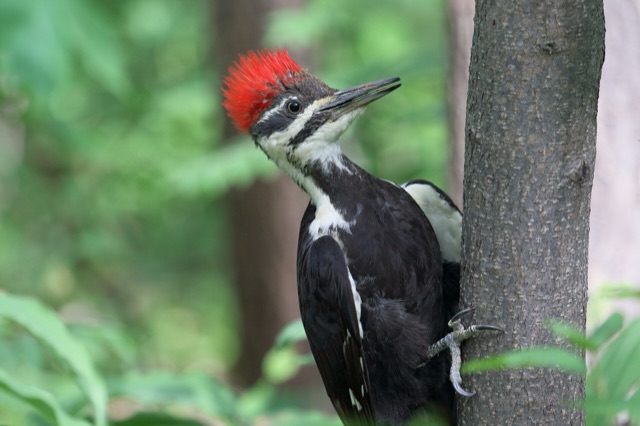
- A big black woodpecker with a bright red crest on its head.
- A white stripe down each side of the head and neck. When it flies, the undersides of its wings flash white.
- Males have a red forehead and a red "mustache" stripe by the bill. On females, those spots are black.
A little about it
This is the biggest woodpecker in North America. It's rare in central Oklahoma, so seeing one is a real treat. They're much easier to find in the forested mountains of eastern Oklahoma.
Pileated Woodpeckers don't migrate. They roam over a big home area, often more than 200 acres. They usually look for food alone or in pairs.
Carpenter ants can be more than half of what it eats. It chops deep holes in dead trees to get at them. Sometimes it tears apart stumps and big chunks of fallen logs. It also eats other bugs, and some berries and nuts. Listen for a loud "cuk-cuk-cuk-cuk" call.
Each year, a pair digs a new nest hole in a dead tree, usually 15 to 80 feet up. The female lays 3 to 5 white eggs. The young leave the nest about 4 weeks after they hatch. They may stay with their parents for 2 or 3 months.
Fun fact
You can spot signs of a Pileated even when the bird is gone. Look for big holes shaped like rectangles in dead trees.
When it's here
- January: here
- February: here
- March: here
- April: here
- May: here
- June: here
- July: here
- August: here
- September: here
- October: here
- November: here
- December: here
Taller bars mean more sightings. Most often seen in March.
How big
15 to 19 inches, with wings more than 2 feet across. About as big as a crow.
Where to look
Big woods with lots of tall, old trees. Some live in patches of woods near the edges of cities.
People have spotted it at Lake Thunderbird State Park.
Could it be something else?
American Crow
In the air, a Pileated can look like a crow. A crow is black under its wings, though. It has no crest and no white stripes on its neck.
More photos
Where these facts come from
- Oklahoma Department of Wildlife Conservation field guide
- Audubon Guide to North American Birds
- When it's here: Sightings shared on iNaturalist in the 8 counties, all years.