All birds Finches, Euphonias, and Allies
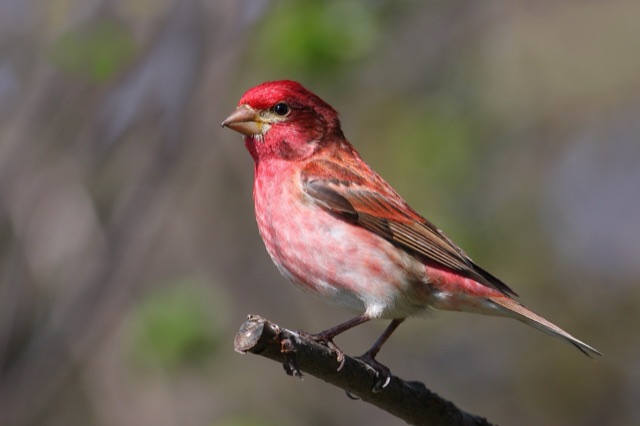

Purple Finch
Haemorhous purpureus
Here November to March.
Recorded by Rolf A. de By. CC BY-NC-SA 4.0, via xeno-canto, trimmed and volume evened out.
Look for
- Males have a raspberry-red head and chest. Red and brown streaks cover the back, wings, and sides.
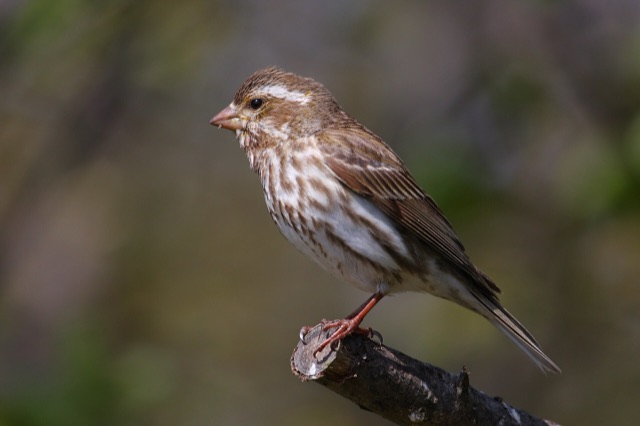
- Females have a white stripe over each eye and a white "mustache." Their white chest and belly have short, dark streaks.
- A small notch at the tip of the tail.
A little about it
Purple finches visit in winter. Look for them from November to March. February has the most.
At feeders, they eat black-oil sunflower seeds. Away from feeders, they eat seeds, buds, berries, and a few bugs. In winter, they eat mostly seeds from trees like ash and elm, and from weeds and grass.
They usually eat in flocks of 5 to 30 birds. They like feeders that are close to trees. A flat tray feeder set just above the ground works, and so do tube feeders.
In spring, they leave to nest in woods, often with pine and other cone trees. The nest sits on a tree branch, most often 15 to 20 feet up. The female lays 4 or 5 pale green-blue eggs with dark marks.
Fun fact
To win a mate, the male hops near the female with his wings drooping, his tail up, and his chest puffed out. Then he shakes his wings so fast that he lifts a little way into the air.
When it's here
- January: here
- February: here
- March: here
- April: a few
- May: a few
- June: not here
- July: not here
- August: not here
- September: not here
- October: not here
- November: here
- December: here
Taller bars mean more sightings. Most often seen in February.
How big
About 6 inches. About the size of a sparrow, and a little chunkier than a House Finch.
Where to look
Woods and brushy, open places. In some winters, lots of them visit neighborhoods with big, old trees.
People have spotted it at Lake Thunderbird State Park.
Could it be something else?
House Finch
A male House Finch has red on his head and chest, but none on his wings and sides. His tail is square at the tip. A female House Finch has a plain brown face and blurry streaks down her front.
More photos
Where these facts come from
- Oklahoma Department of Wildlife Conservation field guide
- Audubon Guide to North American Birds
- When it's here: Sightings shared on iNaturalist in the 8 counties, all years.