All birds Hawks, Eagles, and Kites
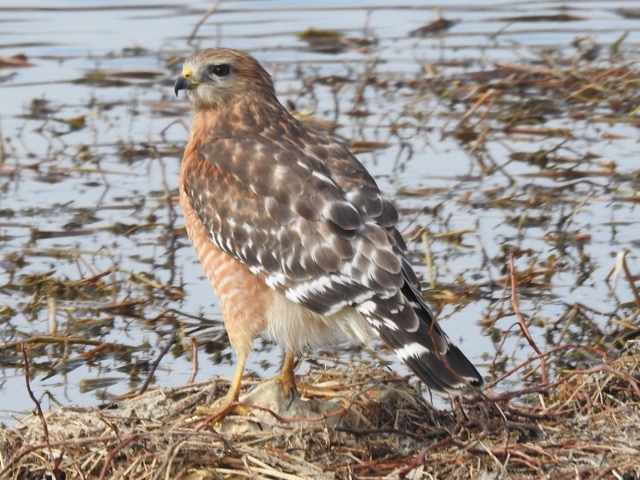
Red-shouldered Hawk
Buteo lineatus
Here all year.
Recorded by Brenna Farrell. CC BY-NC, via iNaturalist, trimmed and volume evened out.
Look for
- Rusty red shoulders and a reddish chest.
- Narrow black and white bands across the wings and tail.
- When it flies, look for a pale, curved patch near each wingtip. Young birds are browner.
A little about it
Red-shouldered Hawks live here all year. They can be easier to spot in fall and winter. That's when some move out of the woods into more open places.
This hawk likes to sit on a branch and watch. When it spots food, it swoops down to grab it. It may listen for its food as well as look for it.
It eats many kinds of small animals. Mice, voles, frogs, and snakes are all on the menu. In some places it eats lots of crayfish.
Both parents build a nest of sticks high in a tree, usually 35 to 65 feet up. The female lays 3 or 4 eggs. The young leave the nest at 5 to 7 weeks old. A pair may use the same nest again the next year.
Fun fact
Its call is a loud scream that drops down at the end: "kee-yeeear." Blue Jays can copy it almost perfectly. So that hawk you hear might be a jay!
When it's here
- January: here
- February: here
- March: here
- April: here
- May: here
- June: here
- July: here
- August: here
- September: here
- October: here
- November: here
- December: here
Taller bars mean more sightings. Most often seen in December.
How big
16 to 24 inches, with wings more than 3 feet across. About as big as a crow.
Where to look
Woods with tall trees near creeks, rivers, and swamps. You'll often hear one before you see it.
People have spotted it at Mitch Park, Oklahoma City Zoo area, Lake Stanley Draper.
Could it be something else?
Red-tailed Hawk
Its tail is reddish on top, with no black and white bands. When it flies over, look for a dark edge along the front of each wing, near the body. Red-tails like open country. Red-shoulders stick close to the woods.
Where these facts come from
- Audubon Guide to North American Birds
- When it's here: Sightings shared on iNaturalist in the 8 counties, all years.