All birds Ducks, Geese, and Waterfowl

Ruddy Duck
Oxyura jamaicensis
Here November to April.
Look for
- A small duck with a stiff, spiky tail. The tail often sticks straight up.
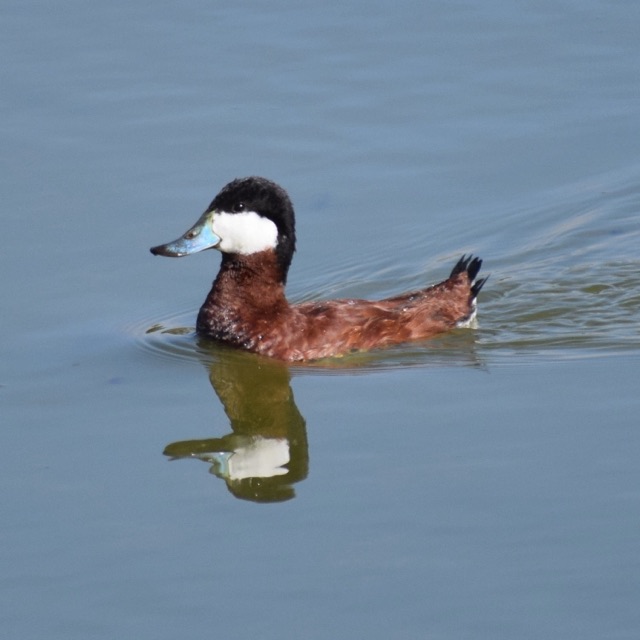
- Males have a dark cap and white cheeks. In nesting season the male also gets a red-brown body and a bright blue bill.
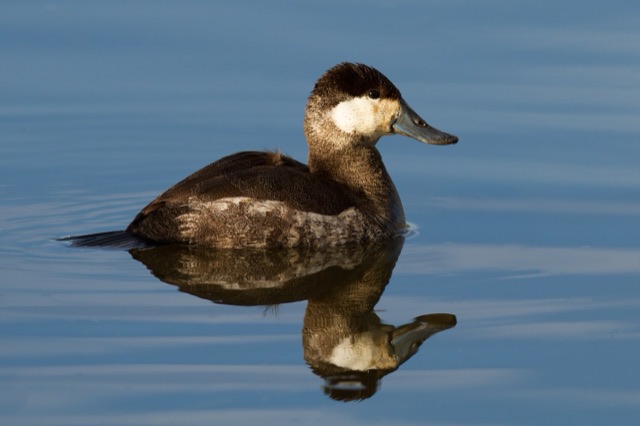
- Females have pale cheeks with a smudgy dark line across them.
A little about it
Ruddy Ducks are winter ducks here. You can find them from November to April. So most of the time, you'll see the plain winter look. The male's red-brown body and bright blue bill are for nesting season.
A Ruddy Duck dives and swims underwater, pushing with its feet. It uses its bill to strain food out of the mud on the bottom. It eats seeds and roots of water plants, plus water bugs and snails.
Ruddy Ducks usually seem slow and sleepy, and they don't like to fly. To take off, one has to patter across the water. Then it whirs along with fast wingbeats. On land, it can hardly get around. They migrate mostly at night, in small flocks.
The nest is a woven platform of grass and cattails, a few inches above the water. Sometimes it's built on top of an old muskrat house. The mom lays about 8 eggs, and they're big for such a small duck. The babies leave the nest within a day, and right away they can swim and dive well.
Fun fact
When a male courts a female, he bounces his head so fast that his bill slaps his chest. It makes ticking and clapping sounds.
When it's here
- January: here
- February: here
- March: here
- April: here
- May: a few
- June: not here
- July: not here
- August: not here
- September: not here
- October: not here
- November: here
- December: here
Taller bars mean more sightings. Most often seen in November.
How big
13 to 17 inches. A little smaller than a crow.
Where to look
Lakes and ponds in winter, out on the open water. Look for a flock off by itself, or near some American Coots.
People have spotted it at Oklahoma City Zoo area, Lake Overholser, Lake Hefner.
Could it be something else?
Bufflehead
Also a small diving duck with white on its head. A male Bufflehead has a white patch like a scarf on a round black head, and his sides are white. A Ruddy Duck has a dark cap over white cheeks, and a stiff tail that often points up.
More photos
Where these facts come from
- Audubon Guide to North American Birds
- When it's here: Sightings shared on iNaturalist in the 8 counties, all years.