All birds New World Vultures
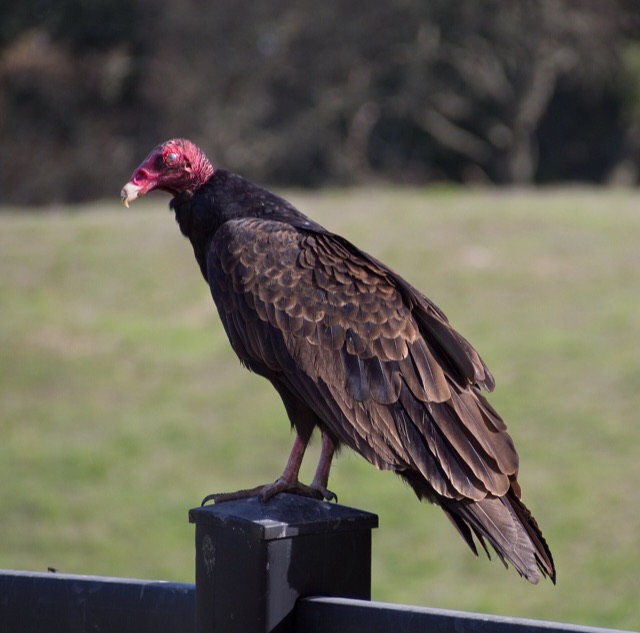

Turkey Vulture
Cathartes aura
Here February to October.
Look for
- A big, dark bird with a small, bare red head. Young birds have a gray head.
- From below, the wings have 2 colors. They're black in front and gray along the back edge.
- It soars with its wings held up in a wide V. It can glide for hours and hardly flap.
A little about it
Turkey Vultures are here from about February to October. You'll see the most in September, and a few stay all winter. In fall, many vultures fly south in flocks. Some go all the way to South America.
Vultures eat animals that are already dead, and they like their food fresh. Most birds can't smell much, but a Turkey Vulture can find a dead animal by its smell. It doesn't kill to eat, so the Cherokee Nation calls it the "peace eagle."
A vulture rides on rising warm air to save its strength. It can travel up to 140 miles in a day. Vultures like company, and 75 to 100 of them may eat or rest in the same spot. A group flying together is called a kettle.
They don't really build a nest. The female lays 2 eggs in a hollow tree or log, a cave, or a crack in a cliff. Both parents keep the eggs warm. The young can fly at about 10 weeks old.
Fun fact
If something gets too close to a vulture nest, the chicks hiss and throw up to protect themselves.
When it's here
- January: a few
- February: here
- March: here
- April: here
- May: here
- June: here
- July: here
- August: here
- September: here
- October: here
- November: a few
- December: a few
Taller bars mean more sightings. Most often seen in September.
How big
25 to 32 inches, with wings 6 feet across. Much bigger than a crow, with very long wings.
Where to look
Look up over open fields, roads, and the edges of woods. You may also see a group on the ground, eating a dead animal.
People have spotted it at Arcadia Lake, Stinchcomb Wildlife Refuge, Lake Stanley Draper.
Could it be something else?
Black Vulture
It has a short tail and a dark gray head. When it flies, look for a whitish patch near each wingtip. It holds its wings flat and flaps fast between glides.
Bald Eagle
Both are big and dark, so people mix them up. A grown-up eagle has a white head and tail. A vulture's head looks tiny, and it soars with its wings in a V.
Where these facts come from
- Oklahoma Department of Wildlife Conservation field guide
- Audubon Guide to North American Birds
- When it's here: Sightings shared on iNaturalist in the 8 counties, all years.