All birds Rails, Gallinules, and Coots
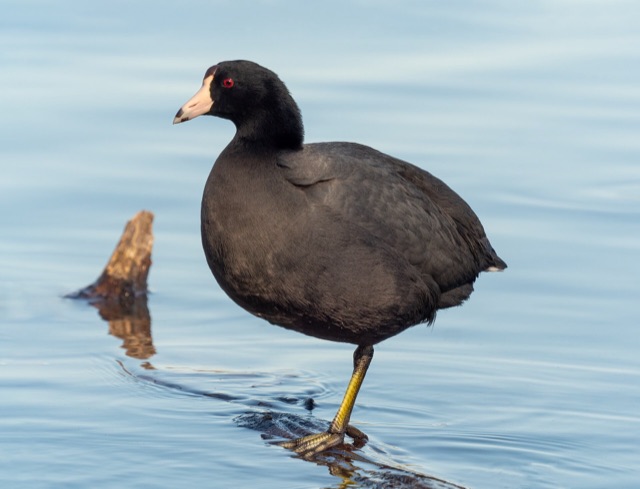

American Coot
Fulica americana
Here September to April.
Recorded by Paul Marvin. CC BY-NC-SA 4.0, via xeno-canto, trimmed and volume evened out.
Look for
- A dark gray body with a blacker head.
- A thick white bill. A white and reddish-brown patch goes from the bill up onto the forehead.
- Big feet with wide flaps along each toe. You can see them when it walks on land.
A little about it
Coots are winter birds here. You can find them from September to April, and November has the most. In summer they're hard to find.
Coots eat mostly plants, like pond weeds and algae. They also eat bugs, snails, tadpoles, and small fish. A coot may dive under the water for food or nibble grass on land. Sometimes it even steals food from ducks!
Coots like to stay in flocks, and they're noisy by day or at night. They cluck, cackle, and grunt. When 2 coots fight over space, they rear up and kick at each other with their feet.
The nest is a raft of dead cattails and other plants that floats on the water. The mother lays 6 to 11 eggs. The chicks can swim soon after they hatch, and they have red heads.
Fun fact
To take off, a coot runs across the top of the water. It flaps its wings hard the whole way until it finally lifts into the air.
When it's here
- January: here
- February: here
- March: here
- April: here
- May: a few
- June: a few
- July: a few
- August: a few
- September: here
- October: here
- November: here
- December: here
Taller bars mean more sightings. Most often seen in November.
How big
About 15 inches. About as big as a crow.
Where to look
Ponds and lakes, even small ones in city parks. Coots also walk around on the grass near the water, like on golf courses.
People have spotted it at Myriad Botanical Gardens, Oklahoma City Zoo area, Lake Hefner.
Could it be something else?
Pied-billed Grebe
Another small, dark swimmer with a thick, pale bill. But a grebe is brown, and it's almost never in a flock. When it's scared, it can sink slowly until only its head sticks out.
Mallard
Both swim on city park ponds. A female Mallard is speckled brown with an orange bill, and a male has a shiny green head. A coot is dark gray with a white bill.
Where these facts come from
- Audubon Guide to North American Birds
- When it's here: Sightings shared on iNaturalist in the 8 counties, all years.