All birds Finches, Euphonias, and Allies
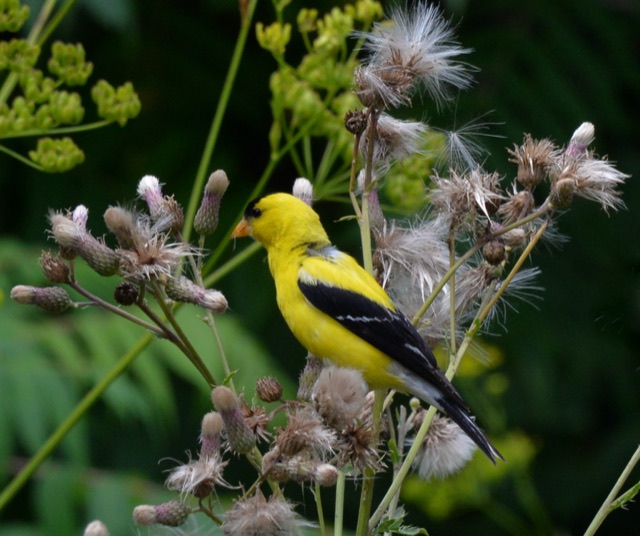

American Goldfinch
Spinus tristis
Here most of the year.
Recorded by Jonathon Jongsma. CC BY-SA 4.0, via Wikimedia Commons, trimmed and volume evened out.
Look for
- In spring and summer, males are bright yellow with a black cap and black wings. Females are a duller yellow-green.
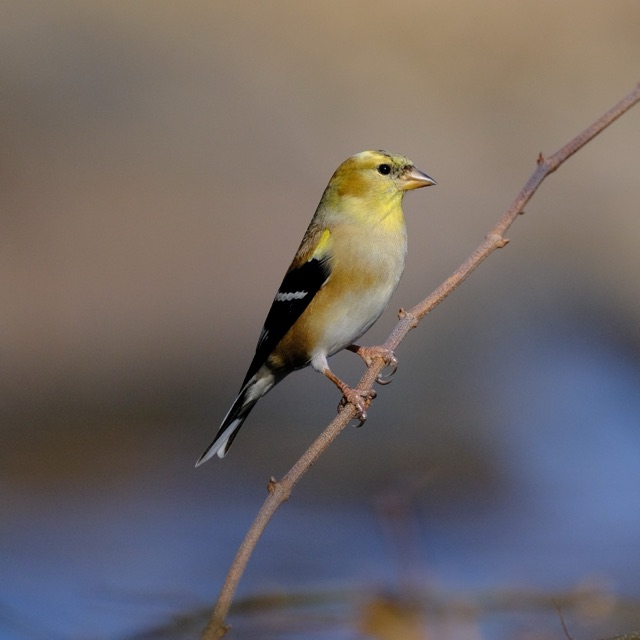
- In winter, males and females both turn plain brown or gray, with just a little yellow on the face and throat.
- Dark wings with white stripes across them. Look for them on summer males and on every goldfinch in winter.
A little about it
You can see goldfinches here most of the year, but there are many more in winter. In September and October, they're hard to find. If you see a flock of plain brown finches at a feeder in winter, they may be goldfinches in their winter colors.
Goldfinches eat mostly seeds, and they climb all over thistle plants like little acrobats to reach them. At feeders, they like sunflower and thistle seed. A tube feeder helps, since big birds have a hard time landing on its short perches.
They almost always eat in flocks and get along well. A flock can be as small as 5 birds or bigger than 150. In winter, when many birds are quiet, goldfinch flocks keep up a busy chatter.
Goldfinches nest later than most birds, mostly in July and August. That may be so there are lots of seeds for the babies. The female builds a cup nest so tight that it may even hold water.
Fun fact
A goldfinch bounces up and down as it flies, like it's riding a wave. On each bounce, it gives a call that sounds like "po-ta-to-chip!"
When it's here
- January: here
- February: here
- March: here
- April: here
- May: here
- June: here
- July: here
- August: here
- September: here
- October: here
- November: here
- December: here
Taller bars mean more sightings. Most often seen in December.
How big
4 to 5 inches. A little smaller than a House Sparrow.
Where to look
Weedy fields, the edges of woods, parks, and gardens. In winter, flocks come to feeders in town.
People have spotted it at Lake Thunderbird State Park, Martin Park Nature Center, Oklahoma City Zoo area.
Could it be something else?
Pine Siskin
It has brown streaks on its back and chest, and yellow on its wings and tail. Check for those streaks to tell it from a goldfinch in winter colors.
More photos
Where these facts come from
- Oklahoma Department of Wildlife Conservation field guide
- Audubon Guide to North American Birds
- When it's here: Sightings shared on iNaturalist in the 8 counties, all years.