All birds Finches, Euphonias, and Allies
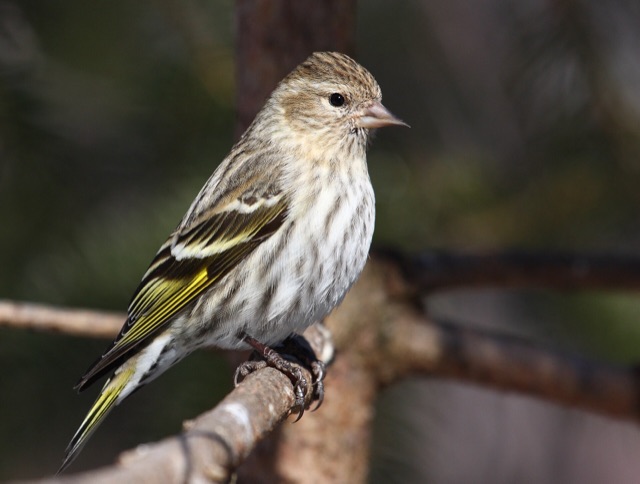

Pine Siskin
Spinus pinus
Here October to May.
Recorded by Andrew Spencer. CC BY-NC-SA 3.0, via xeno-canto, trimmed and volume evened out.
Look for
- Brown and white, with heavy dark streaks all over, even on the belly.
- A thin, sharp, pointed bill.
- Yellow edges on the wings and tail. They show best when it flies.
A little about it
Pine siskins visit in winter, but every winter is different. Some years, huge flocks come south to us. Other years, you may hardly see one. When they do come, look from October to May. November and December are the best months.
They eat mostly seeds from trees like birch and spruce, and from weeds and grasses. They eat a few bugs too. At feeders, they go for thistle and black-oil sunflower seeds, and they like tube feeders best.
Siskins usually eat in flocks, even when they're nesting. Listen for their call. It's a buzzy "bzzzzzt" that goes up at the end.
They raise their babies in forests of pines and other cone trees. Some start to pair up while they're still in their winter flocks. The male flies in circles above the female, with his wings and tail spread wide, and sings.
Fun fact
A Pine Siskin is like a goldfinch wearing a sparrow costume. It has a sparrow's streaks, but it's shaped like a goldfinch and acts like one too. Watch for one hanging upside down to reach seeds.
When it's here
- January: here
- February: here
- March: here
- April: here
- May: here
- June: not here
- July: not here
- August: not here
- September: not here
- October: here
- November: here
- December: here
Taller bars mean more sightings. Most often seen in December.
How big
4½ to 5 inches. Smaller than a House Sparrow, and about the size of a goldfinch.
Where to look
Weedy fields, the edges of woods, pine trees, and neighborhoods. In winter, look for flocks at tube feeders, often mixed in with goldfinches.
People have spotted it at Lake Thunderbird State Park.
Could it be something else?
American Goldfinch
In winter, goldfinches turn plain brown or gray too. But they have no streaks, and their wings have white stripes across them.
House Finch
A female House Finch is streaky brown too. But she's bigger, and she has no yellow on her wings or tail.
Where these facts come from
- Oklahoma Department of Wildlife Conservation field guide
- Audubon Guide to North American Birds
- When it's here: Sightings shared on iNaturalist in the 8 counties, all years.