All birds Troupials and Allies
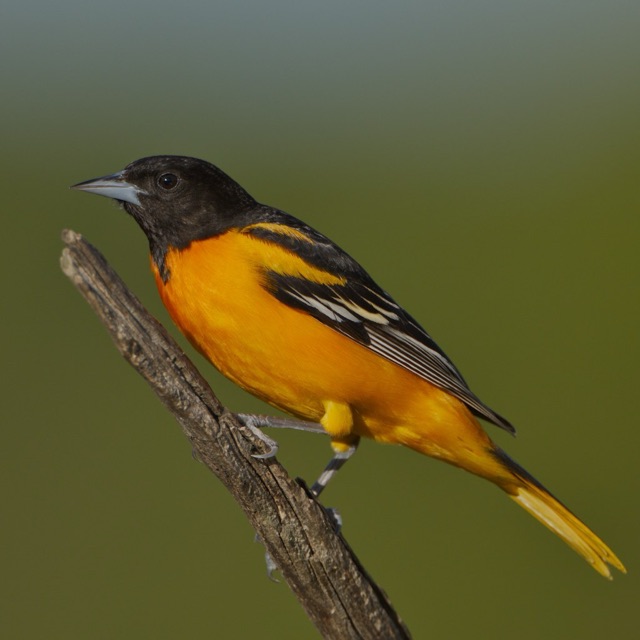
Baltimore Oriole
Icterus galbula
Passes through in April to June and again in August to September.
Recorded by Richard E. Webster. CC BY-NC-SA 4.0, via xeno-canto, trimmed and volume evened out.
Look for
- Grown-up males are bright orange and black, with a bold pattern.
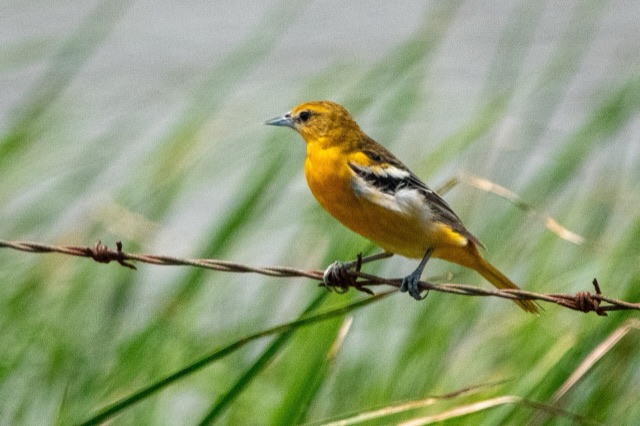
- Females are brown on the back, with an orange wash on the chest and belly.
- Females have white stripes on the wings. Some have black on the head.
A little about it
Baltimore orioles mostly pass through here. The most come in May, on their way north. Fewer pass by again on the way south, and September is the best month then.
They start south early, and many leave in July and August. They travel in flocks and spend the winter mostly in the tropics.
In summer, they eat mostly bugs, even the hairy caterpillars that many birds skip. They also eat berries and sip nectar from flowers. At feeders, they'll drink sugar water and eat bits of fruit.
The nest is a bag that hangs from the end of a thin, droopy branch, usually 20 to 30 feet up. The female weaves it tight out of plant fibers and grass. She may even use string or yarn.
Fun fact
This bird wears the same colors as the coat of arms of Lord Baltimore, who lived in the 1600s. A coat of arms is a kind of family badge.
When it's here
- January: not here
- February: not here
- March: not here
- April: here
- May: here
- June: here
- July: a few
- August: here
- September: here
- October: a few
- November: a few
- December: not here
Taller bars mean more sightings. Most often seen in May.
How big
7 to 8½ inches. Bigger than a sparrow, but smaller than a robin.
Where to look
Big shade trees in town and open woods, especially groves along rivers. They often pick elm trees.
People have spotted it at Martin Park Nature Center, Lake Overholser, Lake Hefner.
Could it be something else?
Orchard Oriole
Smaller. The grown-up male is black and dark reddish brown. The female is yellow-green, without the orange wash of a female Baltimore Oriole.
Summer Tanager
The female is rich yellow, with plain wings and a big, pale bill. A female Baltimore Oriole has white stripes on her wings.
More photos
Where these facts come from
- Audubon Guide to North American Birds
- When it's here: Sightings shared on iNaturalist in the 8 counties, all years.