All birds Troupials and Allies
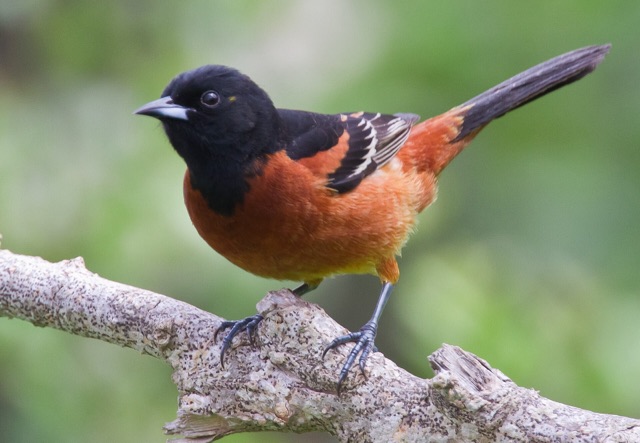

Orchard Oriole
Icterus spurius
Here April to August.
Recorded by Matthew L. Brady. CC BY-NC-SA 4.0, via xeno-canto, trimmed and volume evened out.
Look for
- Grown-up males are black and dark reddish brown.
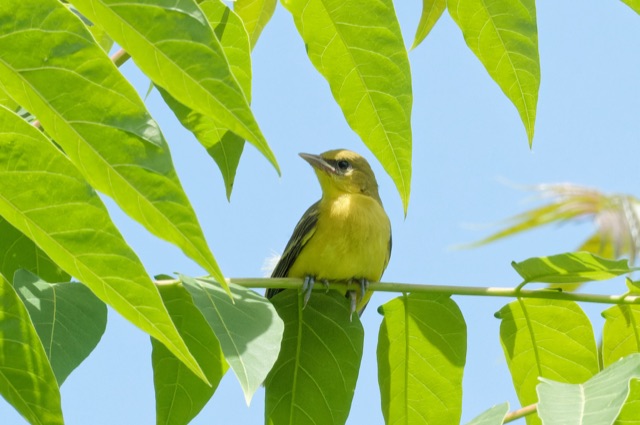
- Females are yellow-green all over.
- Young males look like females, but they have a black throat.
A little about it
Orchard Orioles come here for the summer. May is the best month to look. They head south early, and some are already on the way by late July.
In summer, they eat mostly bugs, especially caterpillars and grasshoppers. They also eat some berries. They often poke their bills into flowers to sip nectar.
The female weaves a nest out of grass that hangs like a little basket, often 10 to 20 feet up in a tree. She lays 4 or 5 eggs. After the young leave the nest, they may stay with mom or dad for a few weeks.
In spring, many fly north across the Gulf of Mexico to get here. They spend the winter in the tropics, at the edges of woods and in brushy places.
Fun fact
Orchard Orioles don't mind close neighbors. Sometimes 2 or more pairs nest in the same tree. They may even share a tree with an Eastern Kingbird.
When it's here
- January: not here
- February: not here
- March: not here
- April: here
- May: here
- June: here
- July: here
- August: here
- September: a few
- October: not here
- November: not here
- December: not here
Taller bars mean more sightings. Most often seen in May.
How big
About 6 to 7 inches. A little bigger than a sparrow, and smaller than a Baltimore Oriole.
Where to look
Look in shade trees in yards and parks, and along rivers. It likes open spots with clumps of trees here and there.
People have spotted it at Lake Stanley Draper, Arcadia Lake, Lake Thunderbird State Park.
Could it be something else?
Baltimore Oriole
A little bigger. The grown-up male is bright orange and black. The female has an orange wash on her chest and belly. A female Orchard Oriole is plain yellow-green.
More photos
Where these facts come from
- Audubon Guide to North American Birds
- When it's here: Sightings shared on iNaturalist in the 8 counties, all years.