All birds Herons, Egrets, and Bitterns
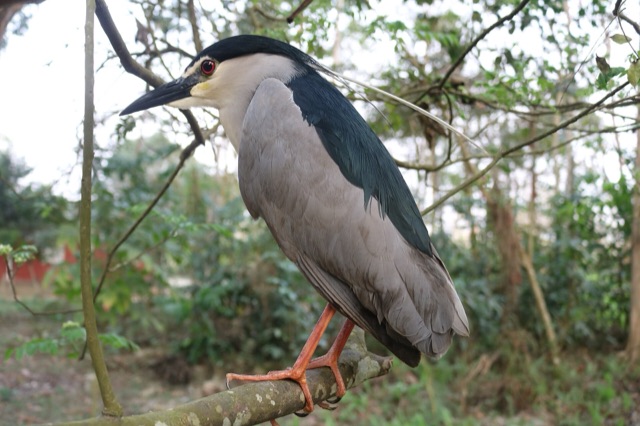

Black-crowned Night Heron
Nycticorax nycticorax
Here April to September.
Recorded by Paul Marvin. CC BY-NC-SA 4.0, via xeno-canto, trimmed and volume evened out.
Look for
- A chunky heron with a black cap and a black back. Its wings are gray.
- In the daytime, it often sits hunched up and very still in a tree by the water.
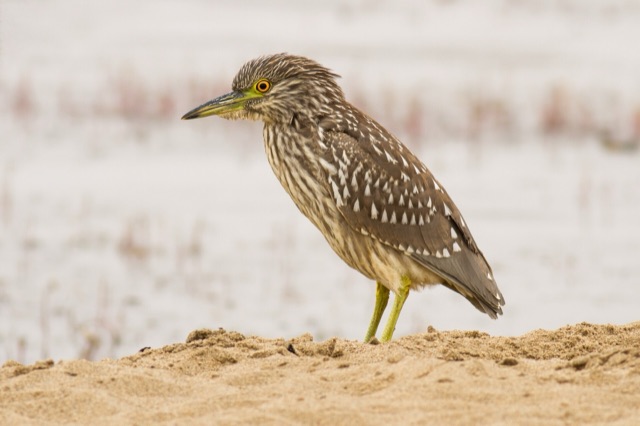
- Young ones look very different. They're brown all over, with white spots.
A little about it
Black-crowned Night Herons spend the summer here. Look for them from April to September. Once in a while, one shows up in winter too.
This heron does most of its hunting from late evening through the night. It stands still or walks slowly at the edge of shallow water. It eats mostly fish, plus frogs, snakes, water bugs, and clams.
At dusk, it flies out to its feeding spot. Listen for a loud, barking "kwok!" from high in the dark sky.
Night herons nest in groups, sometimes with other herons and egrets. The male brings the sticks and the female builds the nest, most often 10 to 40 feet up. The chicks can fly at about 6 weeks old, but for a while they may still follow their parents and beg for food.
Fun fact
Black-crowned Night Herons live all over the world. They nest on every continent except Australia and Antarctica.
When it's here
- January: here
- February: here
- March: a few
- April: here
- May: here
- June: here
- July: here
- August: here
- September: here
- October: a few
- November: here
- December: a few
Taller bars mean more sightings. Most often seen in July.
How big
23 to 26 inches, with wings almost 4 feet across. Bigger than a crow, with a thick, chunky body.
Where to look
Ponds, lakes, rivers, and marshes. Check the trees and bushes along the shore.
People have spotted it at Lake Overholser, Arcadia Lake, Stinchcomb Wildlife Refuge.
Could it be something else?
Yellow-crowned Night Heron
Another stocky night heron. A grown-up is gray all over, with a black and white face. A Black-crowned has a black cap and a black back.
Young Yellow-crowned Night Heron
It's brown and spotted too, so it's hard to tell from a young Black-crowned. Its legs are longer, and its bill is thicker and all black. In flight, its feet stick out much farther past its tail.
More photos
Where these facts come from
- Audubon Guide to North American Birds
- When it's here: Sightings shared on iNaturalist in the 8 counties, all years.