All birds Herons, Egrets, and Bitterns
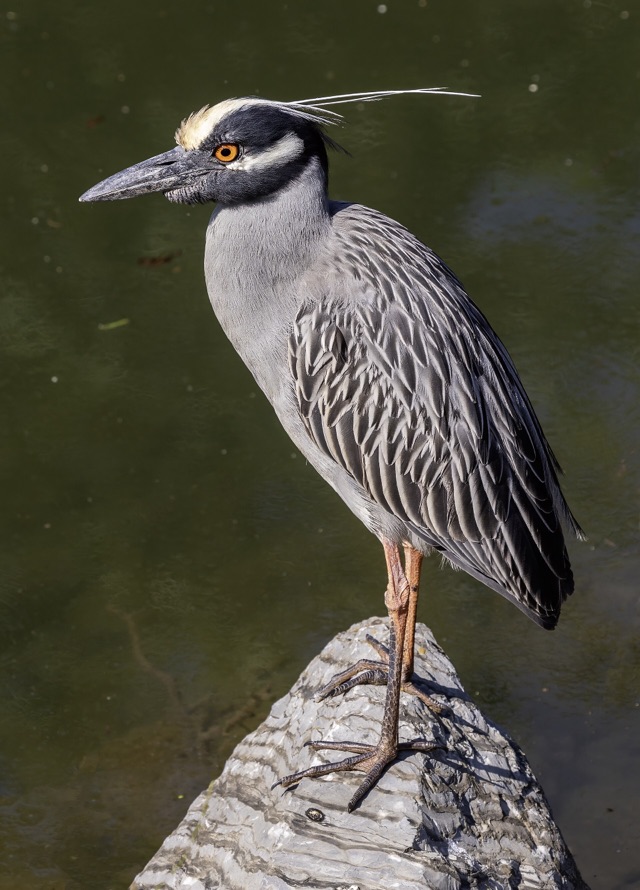

Yellow-crowned Night Heron
Nyctanassa violacea
Here April to September.
Recorded by Paul Marvin. CC BY-NC-SA 4.0, via xeno-canto, trimmed and volume evened out.
Look for
- A short, stocky heron with a soft blue-gray body.
- A black face with a white cheek patch. The top of the head is pale and creamy.
- Big red eyes and long yellow-orange legs. The bill is thick and black.
A little about it
Yellow-crowned Night Herons spend the summer here. Look for them from April to September. June has the most. In winter they fly south, and some go as far as Panama.
This heron hunts both day and night. It wades along the edge of the water to stir up food. Then it stabs fast with its sharp bill.
Crayfish are its favorite food. Its thick bill helps it eat hard-shelled food like that. It also eats fish, frogs, grasshoppers, and once in a while a snake.
The nest is a big pile of sticks near water, 2 or 3 feet across. Sometimes these herons nest in trees right in town. The mother lays 3 to 5 pale blue-green eggs, and both parents take turns keeping them warm.
Fun fact
This heron can eat small turtles. Its stomach has a special acid that helps break down the shell.
When it's here
- January: not here
- February: not here
- March: a few
- April: here
- May: here
- June: here
- July: here
- August: here
- September: here
- October: a few
- November: not here
- December: not here
Taller bars mean more sightings. Most often seen in June.
How big
21 to 28 inches. A bit bigger than a crow. It's about half the size of a Great Blue Heron.
Where to look
Shallow, quiet water along creeks and wetlands, with trees close by. It moves slowly, so look closely.
People have spotted it at Arcadia Lake, Lake Overholser, Lake Hefner.
Could it be something else?
Great Blue Heron
Also gray, and it hunts at the water's edge too. But it's about twice as big and much taller. Its face is mostly white, with a black stripe above each eye.
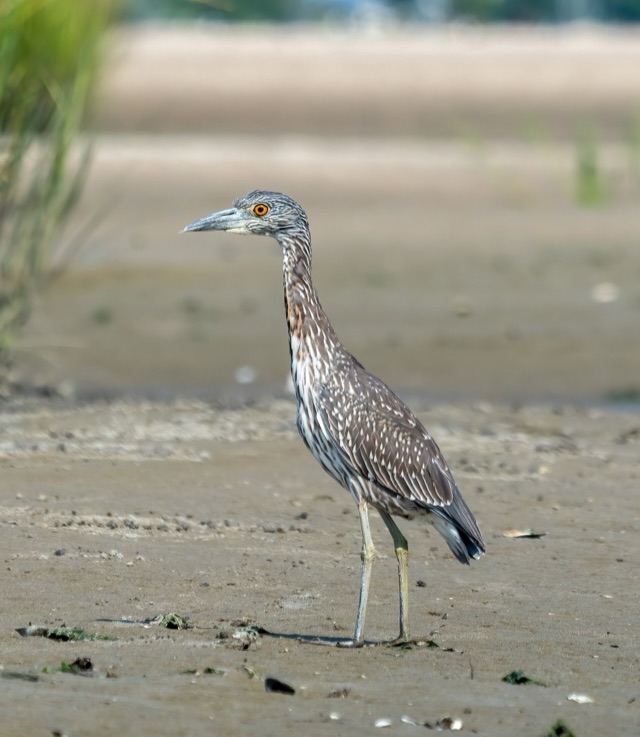
Young Yellow-crowned Night Heron
Young ones are brown and streaky. You'll start to see them in mid-June. They look a lot like young Black-crowned Night Herons, but they have longer legs and a thicker, all-black bill.
More photos
Where these facts come from
- Oklahoma Department of Wildlife Conservation field guide
- Audubon Guide to North American Birds
- When it's here: Sightings shared on iNaturalist in the 8 counties, all years.