All birds Herons, Egrets, and Bitterns
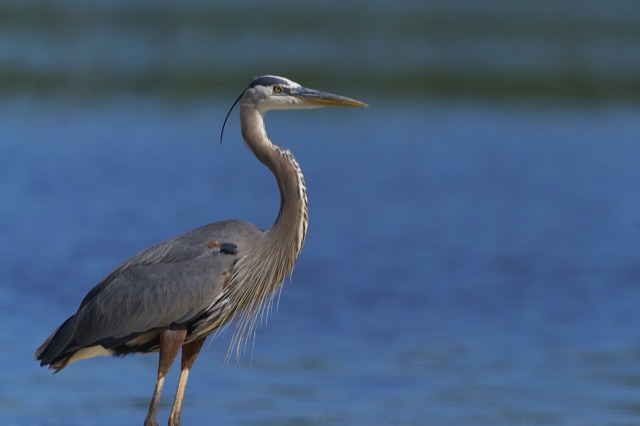

Great Blue Heron
Ardea herodias
Here all year.
Recorded by Thomas G. Graves. CC BY-NC-SA 4.0, via xeno-canto, trimmed and volume evened out.
Look for
- A very tall, gray-blue bird with long legs and a big, heavy bill.
- A whitish face with a black stripe above each eye.
- In the air, it bends its neck into an S and holds its legs straight out behind it.
A little about it
Great Blue Herons live here all year. You'll see the most from August to November. It's the biggest heron in North America.
A heron hunts by standing still in shallow water. When a fish swims close, it strikes fast with its bill. Besides fish, it eats frogs, snakes, turtles, and even gophers it catches in fields.
Herons nest in groups, high in trees near water. The nest is a pile of sticks. They use old nests again and again, and some grow to 3 or 4 feet across.
It flies with slow wingbeats, and it can reach 35 miles per hour.
Fun fact
When a parent heron comes back to the nest with food, the chicks make a noise that sounds like puppies barking.
When it's here
- January: here
- February: here
- March: here
- April: here
- May: here
- June: here
- July: here
- August: here
- September: here
- October: here
- November: here
- December: here
Taller bars mean more sightings. Most often seen in August.
How big
38 to 54 inches, with wings about 6 feet across. Much taller than a goose. Standing up, it's about 4 feet tall.
Where to look
Shallow water along the edge of a lake or creek. Look for a tall gray bird standing very still in shallow water.
People have spotted it at Arcadia Lake, Lake Overholser, Martin Park Nature Center.
Could it be something else?
Young Great Blue Heron
Young herons are gray all over, with a dark cap on the head. They keep that look until their 3rd fall.
Great Egret
Also tall, and it hunts the same way. But it's all white, with a yellow bill and black legs.
Where these facts come from
- Oklahoma Department of Wildlife Conservation field guide
- Audubon Guide to North American Birds
- When it's here: Sightings shared on iNaturalist in the 8 counties, all years.