All birds New World Vultures
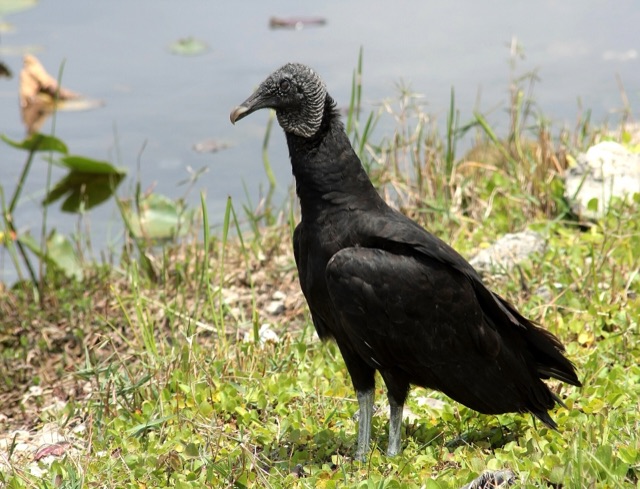

Black Vulture
Coragyps atratus
Here all year.
Look for
- A stocky black bird with a short tail. Its head is dark gray.
- When it flies, a whitish patch shows near the tip of each wing.
- It soars with its wings held flat. Between glides, it gives a few quick flaps.
A little about it
Black Vultures live here all year. You'll usually see them in a flock.
They eat mostly dead animals, big and small. They also eat eggs, and sometimes rotten vegetables or trash from a dump. A Black Vulture often flies very high to look for food. It watches the other vultures too, to see where they find a meal.
Black Vultures hardly ever make a sound. When they do, it's a hiss or a grunt. When a male wants a mate, he may walk in circles around her on the ground. He stretches out his neck and hisses.
They don't build a nest. The female lays 2 pale green eggs with brown blotches. She lays them on the ground under thick bushes, in a hollow log or tree, or in a cave. Some even use an old, empty building. Both parents keep the eggs warm for about 40 days. The parents feed the chicks by bringing up food they've swallowed. The young can fly at about 11 weeks old.
Fun fact
Black Vultures look smaller than Turkey Vultures because their wings and tail are shorter. Their bodies are about the same size, though. And Black Vultures are bossy. They often chase Turkey Vultures away from food.
When it's here
- January: here
- February: here
- March: here
- April: here
- May: here
- June: here
- July: here
- August: here
- September: here
- October: here
- November: here
- December: here
Taller bars mean more sightings. Most often seen in November.
How big
24 to 27 inches, with wings about 4 and a half feet across. Bigger than a crow, with wide wings and a short tail.
Where to look
Look up over open fields and grassland. They rest and nest in the woods, so check the trees nearby too.
People have spotted it at Arcadia Lake, Lake Thunderbird State Park.
Could it be something else?
Turkey Vulture
A grown-up has a red head and a longer tail. It soars with its wings held up in a V. From below, the back half of each wing looks gray. Young Turkey Vultures have gray heads too, but when one sits, it looks browner.
Where these facts come from
- Audubon Guide to North American Birds
- When it's here: Sightings shared on iNaturalist in the 8 counties, all years.