All birds Mockingbirds and Thrashers
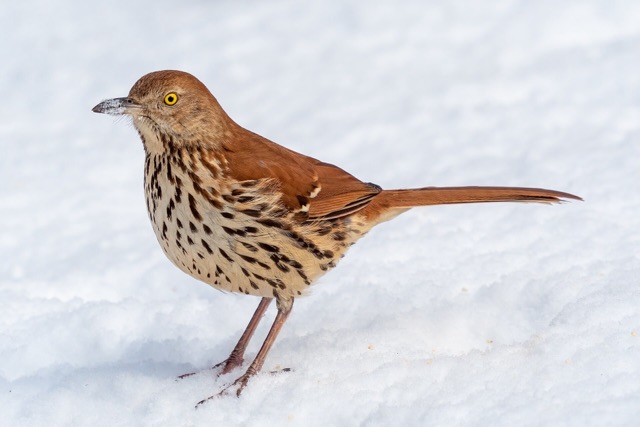

Brown Thrasher
Toxostoma rufum
Here March to October.
Recorded by Bobby Wilcox. CC BY-NC-SA 4.0, via xeno-canto, trimmed and volume evened out.
Look for
- Rusty red-brown on the head, back, wings, and long tail.
- A pale chest and belly with lots of dark brown streaks. Each wing has 2 white bars.
- A long, thin bill that curves down, and yellow eyes.
A little about it
Most Brown Thrashers are here from March to October, and May and June have the most. A few stay all winter in neighborhoods with thick bushes to hide in.
It finds most of its food on the ground. It flips dead leaves with its bill and digs in the dirt for bugs. More than half of what it eats is bugs, like beetles and grasshoppers. It eats berries and acorns too. To crack an acorn, it bangs on it with its bill.
Thrashers are shy. If something scares one, it zips into the bushes and gives a loud "smack!" call. But sometimes a male sings from the top of a tall tree. He sings lots of short tunes, and he sings each one twice.
Both parents build the nest in a thick bush, most often 2 to 7 feet up. It's a big pile of sticks with a loose cup on top. The female lays about 4 pale blue eggs with tiny brown dots. The young leave the nest 9 to 13 days after they hatch.
Fun fact
Brown Thrashers eat mostly bugs and berries. But once in a while, one eats a small lizard or frog!
When it's here
- January: a few
- February: a few
- March: here
- April: here
- May: here
- June: here
- July: here
- August: here
- September: here
- October: here
- November: a few
- December: a few
Taller bars mean more sightings. Most often seen in June.
How big
9 to 12 inches. About as big as a robin, with a longer tail.
Where to look
Thick bushes and tangles at the edges of woods. It also lives in neighborhoods with lots of shrubs and hedges. Look low, near the ground.
People have spotted it at Mitch Park, Stinchcomb Wildlife Refuge, Lake Overholser.
Could it be something else?
Hermit Thrush
Smaller, with a shorter bill and tail. It has spots on its chest, a white ring around each eye, and no white bars on its wings. Its rusty color is only on its wings and tail.
Northern Mockingbird
About the same size, with a long tail too, and it also sings lots of tunes. But it's gray and white, with no rusty brown. A mockingbird sings each part of its song 3 or more times. A thrasher sings each part twice.
Where these facts come from
- Oklahoma Department of Wildlife Conservation field guide
- Audubon Guide to North American Birds
- When it's here: Sightings shared on iNaturalist in the 8 counties, all years.