All birds Tits, Chickadees, and Titmice
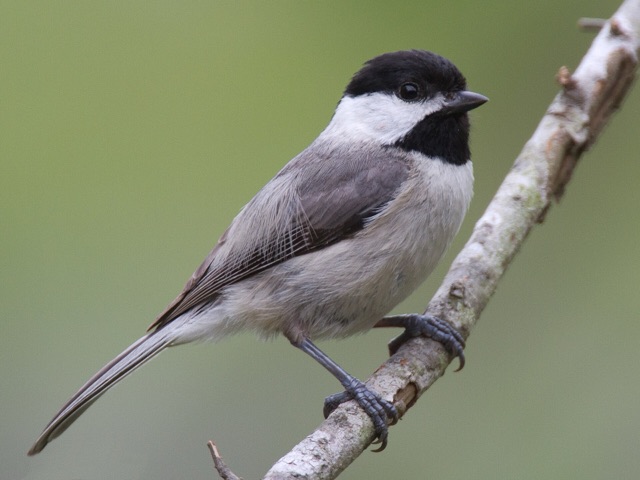

Carolina Chickadee
Poecile carolinensis
Here all year.
Recorded by Chris Harrison. CC BY-NC-SA 3.0, via xeno-canto, trimmed and volume evened out.
Look for
- A black cap on the head and a black bib under the bill.
- Bright white cheeks between the cap and the bib.
- A soft gray back, wings, and tail. The belly is pale, with light tan sides.
A little about it
Chickadees live here all year, and they're easiest to find in winter. Look for small groups of 2 to 8. In winter they often roam with titmice and nuthatches.
At feeders, they love black-oil sunflower seeds and suet. A chickadee takes 1 seed to a branch and holds it with its feet. Then it pounds the shell open with its bill. In spring and summer, most of what it eats is bugs and spiders.
Chickadees often hang upside down from twigs to find food. They hide some seeds to eat later, too. Listen for a buzzy call that sounds like its name: "chick-a-dee-dee-dee."
A pair may stay together for life. They nest in a hole in a tree, often 5 to 15 feet up. The female lays 3 to 10 white eggs with reddish brown dots. The babies leave the nest 13 to 17 days after they hatch.
Fun fact
If something bothers a chickadee on its nest, it gives a loud hiss. It sounds just like a snake!
When it's here
- January: here
- February: here
- March: here
- April: here
- May: here
- June: here
- July: here
- August: here
- September: here
- October: here
- November: here
- December: here
Taller bars mean more sightings. Most often seen in January.
How big
4 to 5 inches. A little smaller than a sparrow.
Where to look
Woods and the trees along creeks, especially oak woods. They're common in yards and parks with big trees, too.
People have spotted it at Lake Thunderbird State Park, Martin Park Nature Center, Mitch Park.
Could it be something else?
Tufted Titmouse
These 2 birds often travel together. A titmouse is a little bigger and has a pointed crest. Its face is plain and pale, with no black cap or bib.
Where these facts come from
- Oklahoma Department of Wildlife Conservation field guide
- Audubon Guide to North American Birds
- When it's here: Sightings shared on iNaturalist in the 8 counties, all years.