All birds Tits, Chickadees, and Titmice
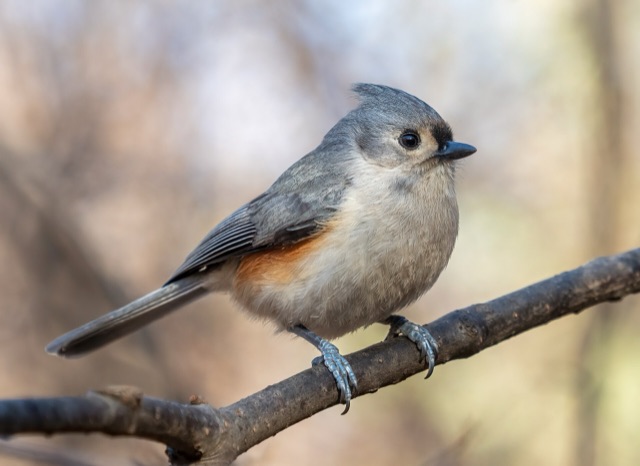

Tufted Titmouse
Baeolophus bicolor
Here all year.
Recorded by Steve Pelikan. CC BY-NC, via iNaturalist, trimmed and volume evened out.
Look for
- Soft gray on top, with a pointed crest on the head.
- A small black patch on the forehead, just above the bill.
- A pale face and belly, with rusty orange sides.
A little about it
Titmice live here all year. They don't migrate, so you can find them in every season. Listen for a whistled song that sounds like "peter, peter, peter."
At feeders, they take black-oil sunflower seeds and suet. A titmouse carries off 1 seed at a time. It holds the seed with its feet and hammers it open with its bill. Sometimes it hides seeds to eat later.
Away from feeders, it hops along branches and often hangs upside down. It eats lots of bugs, and caterpillars are its top food in summer. In winter it eats more seeds, acorns, and berries.
Titmice nest in a hole in a tree, often an old woodpecker hole. The nest can be anywhere from 3 to 90 feet up. Sometimes a young bird from last year stays to help its parents feed the new babies.
Fun fact
A titmouse lines its nest with soft hair. It may pull hair right off a living dog or woodchuck. It has even taken hair from people!
When it's here
- January: here
- February: here
- March: here
- April: here
- May: here
- June: here
- July: here
- August: here
- September: here
- October: here
- November: here
- December: here
Taller bars mean more sightings. Most often seen in March.
How big
About 6 inches. About as big as a sparrow.
Where to look
Woods with tall trees, especially oaks. Titmice also live in yards and parks when the trees are big enough.
People have spotted it at Lake Thunderbird State Park, Arcadia Lake, Martin Park Nature Center.
Could it be something else?
Carolina Chickadee
These 2 often travel together. A chickadee is smaller, with a black cap and a black bib, and it has no crest.
Female Northern Cardinal
She has a crest too, but she's bigger. Look for her thick orange bill and the red on her wings and tail.
Where these facts come from
- Oklahoma Department of Wildlife Conservation field guide
- Audubon Guide to North American Birds
- When it's here: Sightings shared on iNaturalist in the 8 counties, all years.