All birds New World Sparrows
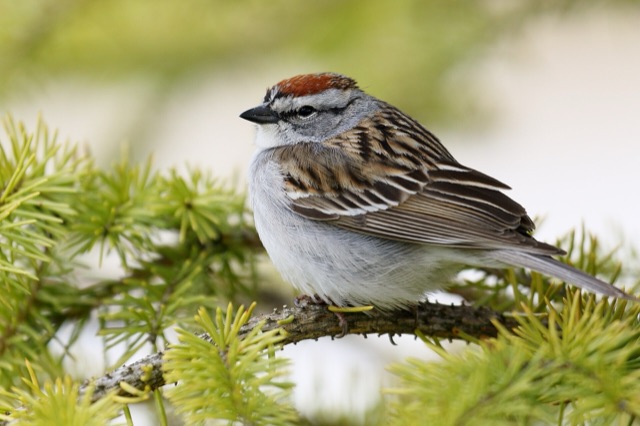

Chipping Sparrow
Spizella passerina
Passes through in March to May and again in October to November.
Recorded by William Whitehead. CC BY-NC-SA 4.0, via xeno-canto, trimmed and volume evened out.
Look for
- A rusty red cap on top of the head.
- A white stripe over the eye, with a thin black line through the eye.
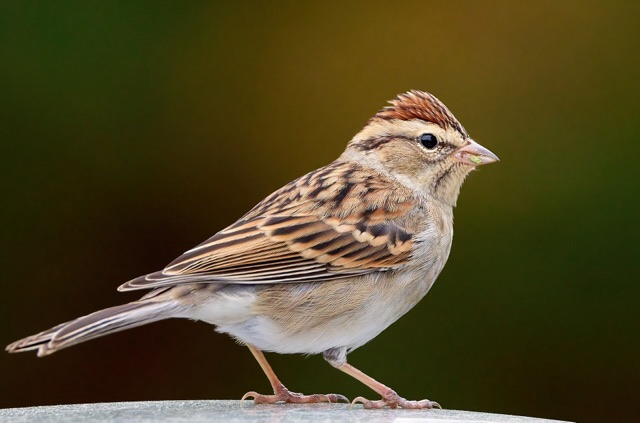
- In fall, the colors are duller and the cap is partly hidden. Males and females look alike.
A little about it
Chipping Sparrows pass through here in spring and fall. Look for them from March to May, then again in October and November. April has the most.
They often travel in flocks when they migrate. In summer, they eat mostly bugs, like grasshoppers and caterpillars. In fall and winter, they eat lots of seeds from grass and weeds.
The nest is a small cup of grass, often in an evergreen tree. It's usually less than 15 feet up. The female lays 3 or 4 pale blue-green eggs, and the babies leave the nest when they're 8 to 12 days old.
Its song is a thin trill that stays on 1 note. Some people say it sounds like a sewing machine.
Fun fact
Long ago, when lots of people kept horses, Chipping Sparrows were known for lining their nests with horse hair.
When it's here
- January: here
- February: a few
- March: here
- April: here
- May: here
- June: not here
- July: not here
- August: not here
- September: a few
- October: here
- November: here
- December: a few
Taller bars mean more sightings. Most often seen in April.
How big
5 to 5½ inches. A small sparrow, about 5 inches long.
Where to look
Parks, yards, farms, and open woods. Look on the ground, where it finds most of its food.
People have spotted it at Arcadia Lake, Martin Park Nature Center, Lake Thunderbird State Park.
Could it be something else?
House Sparrow
A male House Sparrow has a gray cap and a black bib on his throat. A Chipping Sparrow has a rusty cap, with a white stripe and a thin black line below it.
Young Chipping Sparrow
Young birds are streaky at first, and some keep a few streaks into fall. In fall, grown-ups look duller too, with the rusty cap partly hidden.
More photos
Where these facts come from
- Audubon Guide to North American Birds
- When it's here: Sightings shared on iNaturalist in the 8 counties, all years.