All birds Swallows
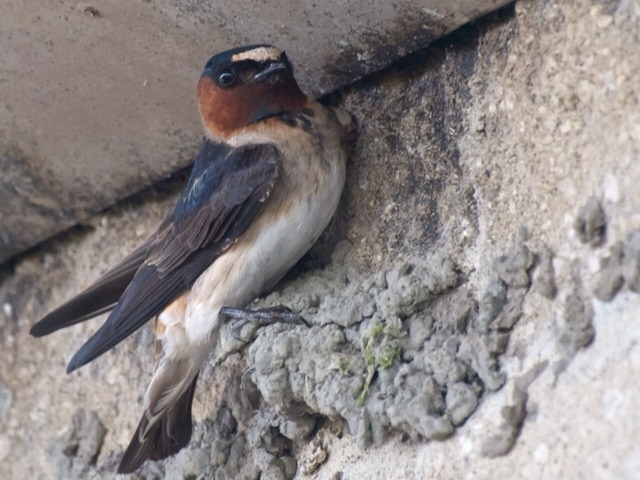

Cliff Swallow
Petrochelidon pyrrhonota
Here April to July.
Recorded by Eric DeFonso. CC BY-NC-SA 4.0, via xeno-canto, trimmed and volume evened out.
Look for
- A short tail with a square tip.
- A pale tan patch on the lower back, right above the tail. Seen from above, it stands out against the dark back and tail.
- A dark reddish-brown throat. Most have a pale spot on the forehead too.
A little about it
Cliff Swallows come here for the summer. April is the best month to see them. For the winter, they fly in flocks all the way to the southern part of South America.
They catch flying bugs in the air, from beetles to wasps. A flock may hunt low over a pond or way up high. In bad weather, they may look for food on the ground.
These swallows nest in big groups, sometimes with hundreds of nests packed close together. Each nest is made of dried mud and shaped like a jug, with a small door on the side. Mom and dad build it together, and they may fix up an old nest and use it again.
The female lays 4 or 5 eggs. The babies leave the nest about 3 weeks after they hatch.
Fun fact
Every spring, people in San Juan Capistrano, California, celebrate the Cliff Swallows coming back. The big day is March 19. The birds really show up there in late February, though.
When it's here
- January: not here
- February: a few
- March: a few
- April: here
- May: here
- June: here
- July: here
- August: a few
- September: not here
- October: a few
- November: a few
- December: not here
Taller bars mean more sightings. Most often seen in April.
How big
About 5 to 6 inches. About as big as a sparrow, with a short, square tail.
Where to look
Open country near water, like farms and lakes. Check under bridges and on the sides of buildings for their mud nests.
People have spotted it at Lake Overholser, Lake Hefner, Lake Thunderbird State Park.
Could it be something else?
Barn Swallow
It has a reddish-brown throat too, so look at the tail. A Barn Swallow's tail is long and splits into 2 points. A Cliff Swallow's tail is short and square.
Where these facts come from
- Audubon Guide to North American Birds
- When it's here: Sightings shared on iNaturalist in the 8 counties, all years.