All birds Cormorants and Shags
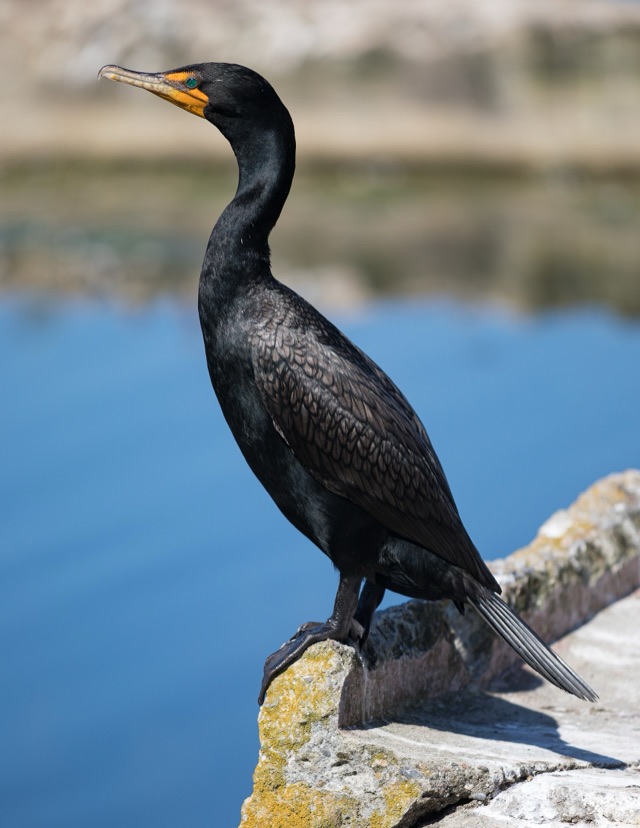

Double-crested Cormorant
Nannopterum auritum
Here October to April.
Recorded by Paul Marvin. CC BY-NC-SA 3.0, via xeno-canto, trimmed and volume evened out.
Look for
- A dark bird that's almost black all over. Up close, it shines green or purple.
- Bright blue-green eyes and a patch of yellow-orange skin on the throat.
- It swims low in the water with its bill tipped up. Often just its head and neck show.
A little about it
Cormorants come here for the winter. You can see them from October to April, and November has the most. More than 50,000 spend the winter in Oklahoma each year. In spring they fly north to nest.
Cormorants eat fish. A cormorant dives from the top of the water and swims with its webbed feet. It can go down 20 feet or more and stay under for about 30 seconds.
Its feathers soak up water. So after a swim, it perches with its wings open to dry them in the sun. To take off from the water, it runs on tiptoe across the top while it flaps.
Cormorants nest in big groups, sometimes more than 1,000 pairs. In the 1960s, a bug spray called DDT made their eggshells thin, and many eggs broke. After DDT was banned, cormorants came back.
Fun fact
Its name comes from 2 small tufts of feathers on its head. Adults grow them in spring, but they're hard to see. Some people call it the "water turkey."
When it's here
- January: here
- February: here
- March: here
- April: here
- May: a few
- June: a few
- July: a few
- August: a few
- September: a few
- October: here
- November: here
- December: here
Taller bars mean more sightings. Most often seen in November.
How big
28 to 35 inches, with wings about 4 feet across. About as big as a goose.
Where to look
Lakes and rivers. Look for one sitting on a rock or in a tree by the water, with its wings held open.
People have spotted it at Oklahoma City Zoo area, Lake Overholser, Martin Park Nature Center.
Could it be something else?
Canada Goose
On the water, people sometimes mix them up. A goose has a brown body and a white strap under its black chin. Both fly in a V, but a cormorant often stops flapping to glide.
Young Double-crested Cormorant
Young ones are brown. Their neck and chest are paler and can look almost white.
Where these facts come from
- Oklahoma Department of Wildlife Conservation field guide
- Audubon Guide to North American Birds
- When it's here: Sightings shared on iNaturalist in the 8 counties, all years.