All birds Troupials and Allies
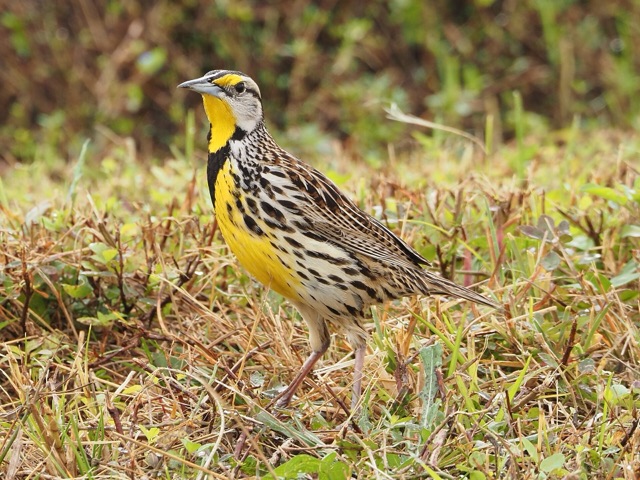

Eastern Meadowlark
Sturnella magna
Here most of the year.
Recorded by Paul Marvin. CC BY-NC-SA 3.0, via xeno-canto, trimmed and volume evened out.
Look for
- A bright yellow chest with a black V across it.
- Dark stripes on the head and a streaky brown back.
- A short tail with white feathers on the sides. They flash when the bird flies up out of the grass.
A little about it
You can find meadowlarks here in every month. In winter their colors are a bit paler, and they don't sing as much.
A meadowlark walks on the ground to find food. In summer it eats lots of bugs, like grasshoppers and crickets. In fall and winter it eats more seeds and grain, and it may look for food in a flock. Some even come to feeders for cracked corn.
Listen for a clear, sweet whistle that sounds like "see-you, see-yeeer." A male sings to keep other meadowlarks out of his nesting space. To show off for a female, he puffs out his chest and points his bill straight up so his black V shows. He may even jump into the air.
The nest is on the ground, hidden in thick grass. The mother lays 2 to 6 eggs. Both parents feed the babies. The babies leave the nest when they're 10 to 12 days old, even before they can fly.
Fun fact
The mother builds a nest with a roof made of grass and a door on the side. Little paths through the grass lead to the nest.
When it's here
- January: here
- February: here
- March: here
- April: here
- May: here
- June: here
- July: here
- August: here
- September: here
- October: here
- November: here
- December: here
Taller bars mean more sightings. Most often seen in October.
How big
7½ to 10 inches. About as big as a robin, but chunky, with a short tail.
Where to look
Grassy fields, pastures, prairies, and grassy roadsides. Look for one singing from the top of a fence post.
People have spotted it at Lake Stanley Draper, Mitch Park, Lake Hefner.
Could it be something else?
Western Meadowlark
Looks almost the same. The best way to tell them apart is the song. A Western Meadowlark sings a bubbly jumble of notes that sound like a flute. An Eastern sings a few clear, simple whistles.
Dickcissel
Also has a yellow chest with a black patch, but it's much smaller, about as big as a sparrow. Dickcissels aren't here in winter. The song sounds like its name: "dick-dick-cissel."
Where these facts come from
- Oklahoma Department of Wildlife Conservation field guide
- Audubon Guide to North American Birds
- When it's here: Sightings shared on iNaturalist in the 8 counties, all years.