All birds Cardinals and Allies
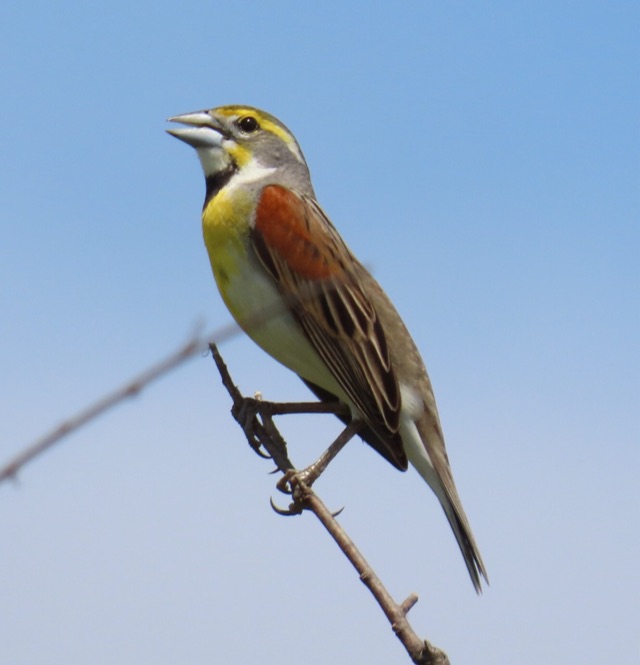
Dickcissel
Spiza americana
Here April to July.
Recorded by Whitney Neufeld-Kaiser. CC BY-NC-SA 4.0, via xeno-canto, trimmed and volume evened out.
Look for
- Males have a black bib on a yellow chest.
- Rusty red on the shoulder. Females have it too.
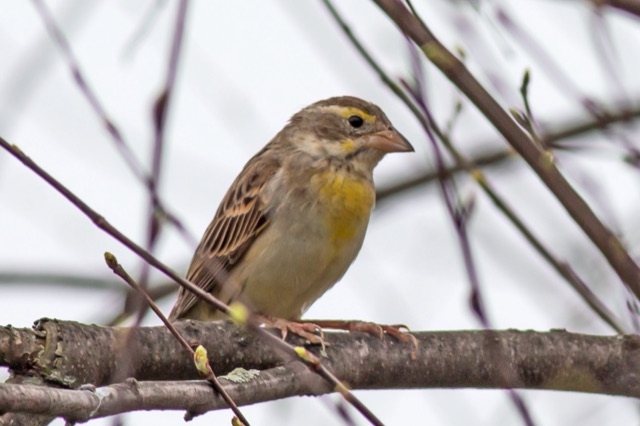
- Females look a lot like a House Sparrow, with a little yellow on the chest.
A little about it
Dickcissels spend the summer here. Look for them from April to July. Most fly to the tropics for the winter. They migrate in flocks, and some flocks have hundreds of birds.
In early summer, they eat mostly bugs, like grasshoppers and crickets. The rest of the year, they eat more seeds from weeds and grass, plus grain from farms.
The nest is a bulky cup, well hidden in thick grass or weeds, on or near the ground. The female lays about 4 pale blue eggs. Only she feeds the babies. They leave the nest at 7 to 10 days old, but they can't fly for a few more days.
Their numbers jump around a lot. A field can be full of Dickcissels one summer and have none the next. Rain may be the reason, since it changes how the fields grow.
Fun fact
Its song sounds like its own name: "dick-dick-cissel." A male sings it over and over from a fence post or the top of a tall weed.
When it's here
- January: not here
- February: not here
- March: not here
- April: here
- May: here
- June: here
- July: here
- August: a few
- September: here
- October: a few
- November: not here
- December: not here
Taller bars mean more sightings. Most often seen in May.
How big
About 6 inches. About as big as a sparrow.
Where to look
Prairies and farm fields with tall grass or alfalfa. Watch the fence lines, where males sit up high to sing.
People have spotted it at Stinchcomb Wildlife Refuge.
Could it be something else?
Eastern Meadowlark
It also has a yellow chest with black on it, but the black makes a V. It's bigger and chunkier, with a short tail that flashes white on the sides when it flies up.
House Sparrow
A female Dickcissel looks a lot like a House Sparrow. Check for a little yellow on the chest and some rusty red on the shoulder. Those mean Dickcissel.
More photos
Where these facts come from
- Audubon Guide to North American Birds
- When it's here: Sightings shared on iNaturalist in the 8 counties, all years.