All birds Pigeons and Doves
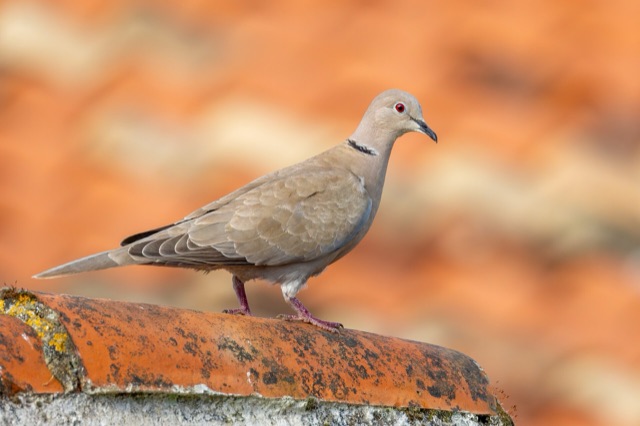

Eurasian Collared-Dove
Streptopelia decaocto
Here all year.
Recorded by Sue Riffe. CC BY-NC-SA 4.0, via xeno-canto, trimmed and volume evened out.
Look for
- A pale gray-brown dove. Males and females look alike.
- A thin black ring on its neck. That's the "collar" in its name.
- Big white patches on the outside edges of its square-tipped tail.
A little about it
The "Eurasian" in this dove's name stands for Europe and Asia, where it comes from. In 1974, people brought some to the Bahamas by accident. Soon the doves spread to Florida. Since the 1980s, they've moved west and north across much of North America. Scientists are still learning how they get along with the birds that were already here. So far, they haven't seen any clear harm.
Collared-doves don't migrate, so you can see them here all year. You'll see the most in late summer and early fall. They eat mostly seeds, plus some berries and bugs. When they aren't nesting, they often feed in flocks.
Listen for a deep "kuk-KOOOO-kuk," over and over. To show off, a male flies up steeply with noisy wings. Then he glides down in a spiral with his wings and tail spread wide.
The male shows the female some places to nest, and she picks one. He brings the sticks, and she builds a thin, floppy nest in a tree or bush. She usually lays 2 white eggs. Both parents feed the babies a special food called "pigeon milk."
Fun fact
Young collared-doves often fly a long way from home to find a place of their own. That's one reason these doves have spread so fast.
When it's here
- January: here
- February: here
- March: here
- April: here
- May: here
- June: here
- July: here
- August: here
- September: here
- October: here
- November: here
- December: here
Taller bars mean more sightings. Most often seen in September.
How big
About 12 inches. A little bigger than a Mourning Dove.
Where to look
Towns and farms with trees and open ground mixed together. They do best in small towns. Look for them walking on the ground as they feed.
People have spotted it at Oklahoma City Zoo area, Myriad Botanical Gardens, Lake Hefner.
Could it be something else?
Mourning Dove
A little smaller, with black spots on its wings and a long, pointed tail. A collared-dove has a black ring on its neck and a square-tipped tail.
Where these facts come from
- Audubon Guide to North American Birds
- When it's here: Sightings shared on iNaturalist in the 8 counties, all years.