All birds Gulls, Terns, and Skimmers
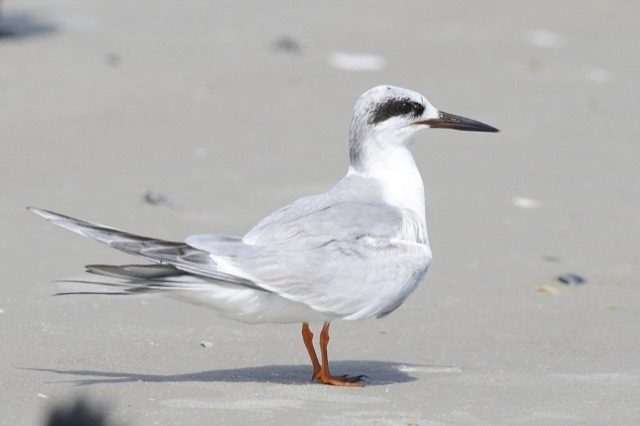

Forster's Tern
Sterna forsteri
Here July to January.
Recorded by Paul Marvin. CC BY-NC-SA 4.0, via xeno-canto, trimmed and volume evened out.
Look for
- In fall and winter, a mostly white head with a bold black patch on each side. The 2 patches don't meet at the back of the head.
- A long tail with a fork in it, like 2 points.
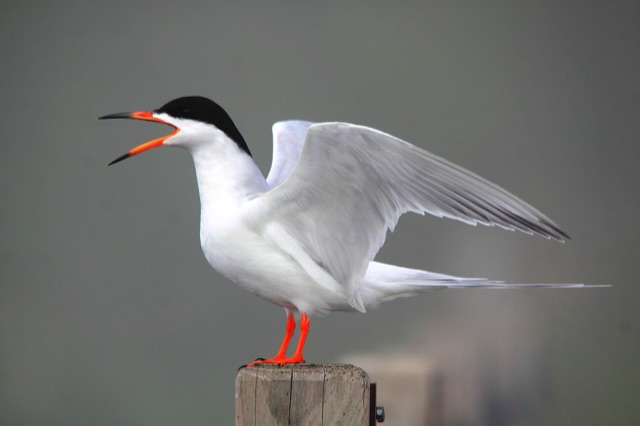
- In spring and summer, grown-ups have a black cap. Their bill is orange near the face.
A little about it
Forster's Terns are seen here mostly from late summer into winter. A few pass through in spring too. Most of them spend the winter on warm coasts down south.
It eats mostly fish. A tern flies over the water and hovers in one spot. Then it plunges down to grab a fish just under the surface. It also catches bugs in the air, and sometimes it eats frogs.
They nest in marshes. The nest sits on thick plants or on a mat of dead plants that floats. Both parents build it out of reeds and grass. There are usually 3 eggs, and the parents take turns keeping them warm for 23 to 25 days. Near the nest, they chase off other birds.
This tern looks a lot like the Common Tern. The first bird experts mostly missed it because the 2 look so alike.
Fun fact
A Forster's Tern often builds its nest on top of a muskrat's house in the marsh.
When it's here
- January: here
- February: a few
- March: a few
- April: here
- May: here
- June: not here
- July: here
- August: here
- September: here
- October: here
- November: here
- December: here
Taller bars mean more sightings. Most often seen in August.
How big
13 to 15 inches, with wings 2 and a half to almost 3 feet across. A little smaller than a crow, with long, pointed wings.
Where to look
Over lakes and marshes. Look for a white bird with long, pointed wings flying over the water.
People have spotted it at Lake Hefner, Lake Overholser, Lake Thunderbird State Park.
Could it be something else?
Ring-billed Gull
Bigger, with a yellow bill that has a black ring around it. It often walks around on land looking for scraps. A tern hunts by diving into the water from the air.
Franklin's Gull
About the same size. In fall, young Franklin's Gulls have a dark patch on the back of the head, like a scarf. A tern's 2 black patches don't meet in back.
More photos
Where these facts come from
- Audubon Guide to North American Birds
- When it's here: Sightings shared on iNaturalist in the 8 counties, all years.