All birds Ducks, Geese, and Waterfowl
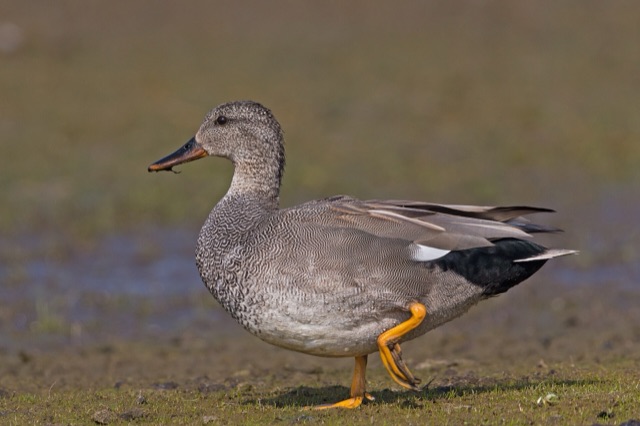

Gadwall
Mareca strepera
Here November to March.
Recorded by Richard E. Webster. CC BY-NC-SA 4.0, via xeno-canto, trimmed and volume evened out.
Look for
- Males are mostly gray, with black at the back end by the tail.
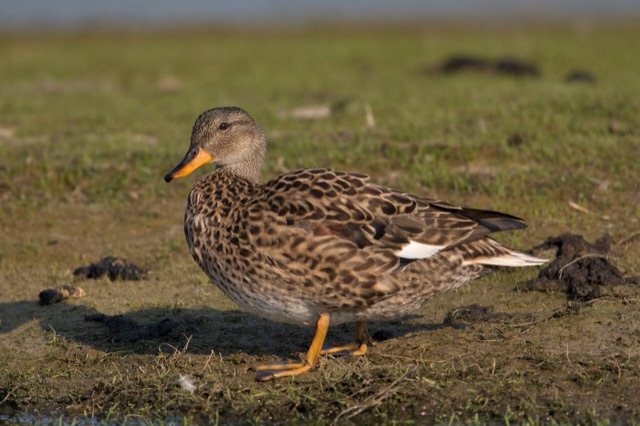
- Females are speckled brown. Their bill is orange and gray.
- A square white patch on the back edge of the wing. You see it best when the duck flies.
A little about it
Gadwalls are winter ducks here. You can find them from November to March, and February has the most.
In lots of ducks, the males are bright and fancy. A male Gadwall looks plain gray from far away. Get a close look and you'll see soft, pretty colors.
Gadwalls eat mostly water plants. Compared to ducks that feed the same way, they eat more leaves and stems. They pick food off the top of the water or dip their heads under. Now and then they tip up or even dive.
Gadwalls don't fly very far for winter. Most stay north of the tropics. To show off, a male pulls his head back and lifts his back end out of the water. He raises his wingtips to show the white patch.
Fun fact
Sometimes 2 or more Gadwall moms lay their eggs in the same nest.
When it's here
- January: here
- February: here
- March: here
- April: a few
- May: a few
- June: not here
- July: a few
- August: a few
- September: not here
- October: a few
- November: here
- December: here
Taller bars mean more sightings. Most often seen in February.
How big
19 to 22 inches. A bit bigger than a crow.
Where to look
Ponds, lakes, and marshes. Gadwalls feed while they swim, so look out on the water.
People have spotted it at Lake Hefner, Martin Park Nature Center.
Could it be something else?
Mallard
A female Mallard is speckled brown too, with an orange bill. Look at the wing patch. A Mallard's is blue, and a Gadwall's is white. A Gadwall also has a steeper forehead.
Northern Shoveler
The female is speckled brown with an orange and gray bill, like a female Gadwall. But a shoveler's bill is huge and shaped like a spoon.
More photos
Where these facts come from
- Audubon Guide to North American Birds
- When it's here: Sightings shared on iNaturalist in the 8 counties, all years.