All birds Tyrant Flycatchers
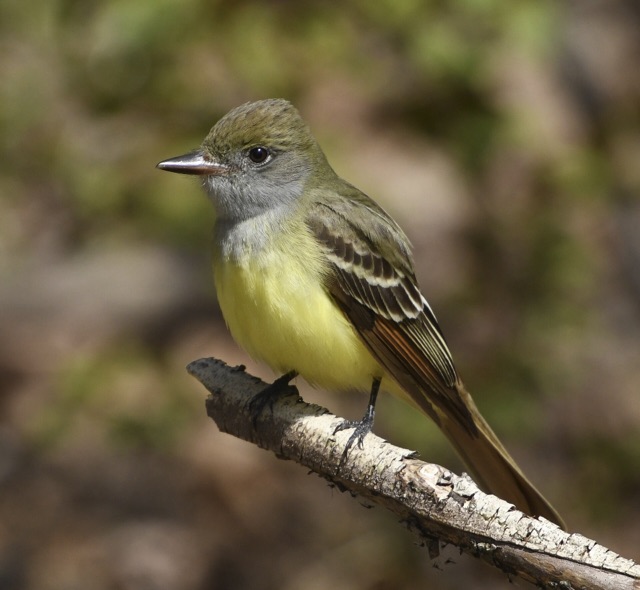

Great Crested Flycatcher
Myiarchus crinitus
Here April to September.
Recorded by Richard E. Webster. CC BY-NC-SA 4.0, via xeno-canto, trimmed and volume evened out.
Look for
- A gray throat and chest, with a bright yellow belly below.
- An olive-brown head and back. The feathers on its head can stick up in a bushy crest, but you won't always see it.
- Reddish brown on the wings and tail. It's easy to spot when the bird flies.
A little about it
Great Crested Flycatchers spend the summer here. Look for them from April to September. May has the most.
This bird is easier to hear than to see. Listen for a loud, whistled "wheep!" It also gives a rough "whit-whit-whit-whit."
It sits on a branch, then flies out to grab bugs. It eats caterpillars, moths, butterflies, katydids, crickets, and beetles. It eats spiders and berries too, and once in a while a small lizard.
It nests in a hole in a tree, like an old woodpecker hole, usually 20 to 50 feet up. Sometimes it uses a birdhouse or even a hollow fence post. The female lays about 5 eggs, and the young can fly when they're 12 to 18 days old.
Fun fact
It usually tucks a piece of old snakeskin into its nest. Snakes shed their skin, and the bird picks up a scrap. Sometimes it uses a bit of clear plastic instead!
When it's here
- January: not here
- February: not here
- March: not here
- April: here
- May: here
- June: here
- July: here
- August: here
- September: here
- October: not here
- November: not here
- December: not here
Taller bars mean more sightings. Most often seen in May.
How big
8 to 8½ inches. A little smaller than a robin.
Where to look
Woods with tall, leafy trees, deep in the forest or along the edges of open spots. It stays high in the treetops, so listen for it first.
People have spotted it at Martin Park Nature Center, Lake Thunderbird State Park, Lake Hefner.
Could it be something else?
Western Kingbird
It has a gray chest and a yellow belly too, and it's here in summer. But its tail is black with thin white edges, and it has no reddish brown on its wings. It sits out in more open places, like farms and roadsides.
Where these facts come from
- Audubon Guide to North American Birds
- When it's here: Sightings shared on iNaturalist in the 8 counties, all years.