All birds Tyrant Flycatchers
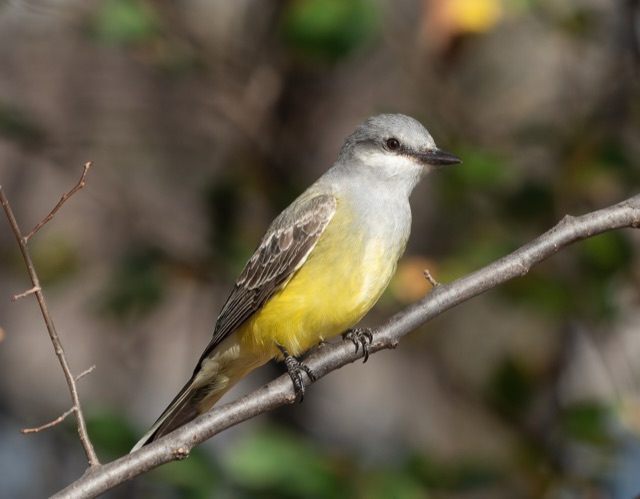

Western Kingbird
Tyrannus verticalis
Here April to July.
Recorded by Paul Marvin. CC BY-NC-SA 4.0, via xeno-canto, trimmed and volume evened out.
Look for
- A bright yellow belly.
- A gray head and chest. A darker gray patch runs through the eye, like a mask.
- A black tail with thin white edges along the sides.
A little about it
Western kingbirds come here for the summer. You can see them from April through July. In August, most of them leave, often in small flocks.
A kingbird watches from a perch. Then it flies out and snaps up a bug in its bill. Sometimes it hovers in the air and drops to the ground to grab one. It eats lots of wasps, bees, beetles, and grasshoppers, and a few berries too.
It often builds its nest on a power pole, right where the wires attach. The female lays 3 to 5 eggs, and both parents feed the babies. The young leave the nest about 16 or 17 days after they hatch.
At the first hint of daylight, the male sings his "dawn song" over and over. To win a mate, he flies up and down in quick zigzags and sputters out calls.
Fun fact
A Western Kingbird is only 8 to 9½ inches long, but it's bold. It flies out to pester ravens and hawks that come too close to its nest.
When it's here
- January: not here
- February: not here
- March: not here
- April: here
- May: here
- June: here
- July: here
- August: a few
- September: not here
- October: not here
- November: not here
- December: not here
Taller bars mean more sightings. Most often seen in July.
How big
8 to 9½ inches. A little smaller than a robin.
Where to look
Open country with fences and a few trees. Look for one on a wire or fence by the road. They live in towns too, even on busy streets.
People have spotted it at Lake Overholser, Lake Hefner.
Could it be something else?
Scissor-tailed Flycatcher
It has a pale belly with pink sides, and a very long tail that splits in 2. Young scissor-tails have shorter tails, so check the belly. A bright yellow belly means Western Kingbird.
Eastern Kingbird
Same shape, but it's black on top and white below, with no yellow. Its tail has a white band across the tip.
Where these facts come from
- Audubon Guide to North American Birds
- When it's here: Sightings shared on iNaturalist in the 8 counties, all years.