All birds Tyrant Flycatchers
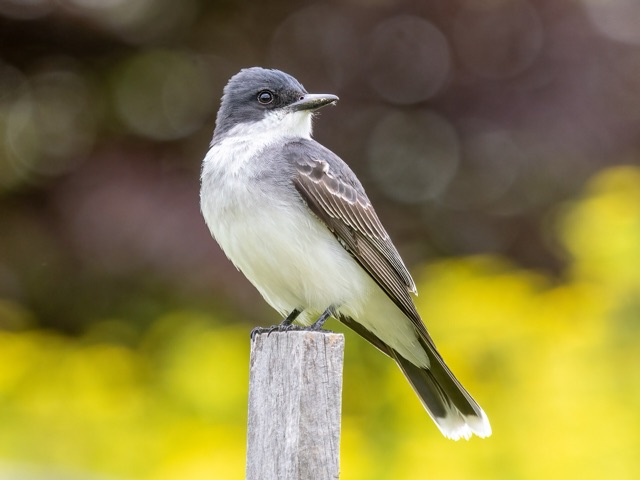

Eastern Kingbird
Tyrannus tyrannus
Here April to September.
Recorded by Greg Irving. CC BY-NC-SA 4.0, via xeno-canto, trimmed and volume evened out.
Look for
- A head and back that are black or dark gray.
- Bright white from the throat all the way down the belly.
- A black tail with a clean white band across the tip. That band is the best mark to look for.
A little about it
Eastern kingbirds spend the summer here. You can see them from April to September. May is when you'll see the most.
A kingbird sits on a perch and watches for bugs. When one flies by, it flutters out and grabs it in midair. It eats lots of beetles, bees, wasps, and grasshoppers. It eats berries and wild fruit too.
The female builds a big, bulky cup of twigs and weed stems. It's usually in a tree or a big bush, 7 to 30 feet up. Sometimes she picks an odd spot, like the top of a fence post or a dead tree standing in water. The young can fly at about 16 to 18 days old, but their parents may keep caring for them for more than a month.
For the winter, kingbirds fly all the way to South America. They travel in flocks, mostly in the daytime. Down there, they act like a different bird. They live in flocks in tropical forests and eat lots of berries.
Fun fact
An Eastern Kingbird has a patch of red, orange, or yellow feathers on top of its head. It's almost always hidden. But a male may flash it while he zigzags and does backward flips in the air to win a mate.
When it's here
- January: not here
- February: not here
- March: not here
- April: here
- May: here
- June: here
- July: here
- August: here
- September: here
- October: not here
- November: a few
- December: not here
Taller bars mean more sightings. Most often seen in May.
How big
7½ to 9 inches. A little smaller than a robin, with a big head.
Where to look
Open places with some trees, like farms, roadsides, and the edges of woods and marshes. Look for one sitting up straight on a treetop or a fence wire.
People have spotted it at Lake Stanley Draper, Arcadia Lake, Mitch Park.
Could it be something else?
Eastern Phoebe
Smaller and browner, with no white band on its tail. A phoebe wags its tail while it sits.
Western Kingbird
Same size and shape, but its head is gray and its belly is bright yellow. Its tail has thin white edges on the sides, with no white band at the tip.
Where these facts come from
- Audubon Guide to North American Birds
- When it's here: Sightings shared on iNaturalist in the 8 counties, all years.