All birds Woodpeckers
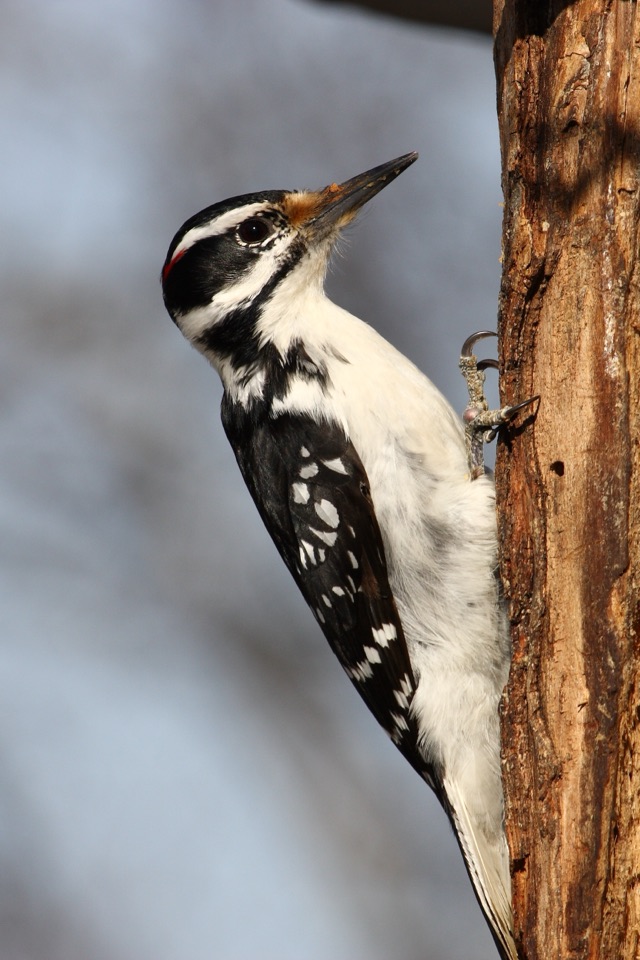

Hairy Woodpecker
Leuconotopicus villosus
Here all year.
Recorded by Ed Pandolfino. CC BY-NC-SA 4.0, via xeno-canto, trimmed and volume evened out.
Look for
- Black and white, with a white stripe down the middle of the back and white spots on the black wings.
- A long bill, about as long as its head.
- Males have a small red patch on the back of the head. Females have no red.
A little about it
Hairy Woodpeckers live here all year and don't migrate. They're less common than Downy Woodpeckers, though, so it takes some luck to spot one. Listen for a sharp "peek!" call that's louder than a Downy's.
It eats mostly bugs, especially beetle grubs. Grubs are baby beetles that tunnel inside wood. The Hairy pounds and digs into trees to reach them.
It also eats some berries, seeds, and nuts, and it comes to feeders for suet. It will even sip sap from the little holes that sapsuckers drill.
Both parents dig the nest hole in a tree, from 4 to 60 feet up. The female lays about 4 white eggs, and the male sits on them at night. The young leave the nest 28 to 30 days after they hatch.
Fun fact
When a pair gets ready to nest, the male and female drum on trees together, like a duet.
When it's here
- January: here
- February: here
- March: here
- April: here
- May: here
- June: here
- July: here
- August: here
- September: here
- October: here
- November: here
- December: here
Taller bars mean more sightings. Most often seen in June.
How big
7 to 10 inches. Nearly as big as a robin.
Where to look
Woods with big, old trees, like oaks and cottonwoods. Hairies need large trees, so they aren't common in towns here.
People have spotted it at Martin Park Nature Center, Lake Thunderbird State Park.
Could it be something else?
Downy Woodpecker
Same black and white pattern, but smaller, about the size of a sparrow. Its bill is short, much shorter than its head. A Hairy's bill is about as long as its head.
Where these facts come from
- Oklahoma Department of Wildlife Conservation field guide
- Audubon Guide to North American Birds
- When it's here: Sightings shared on iNaturalist in the 8 counties, all years.