All birds New World Sparrows
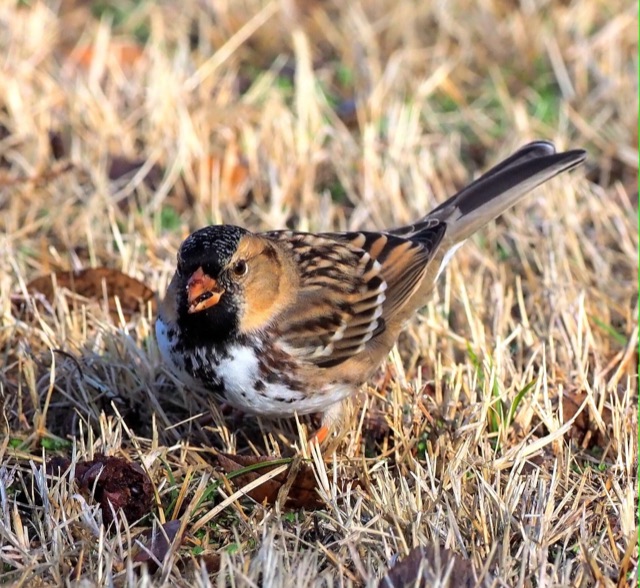
Harris's Sparrow
Zonotrichia querula
Here November to April.
Recorded by Don Profota. CC BY-NC-SA 4.0, via xeno-canto, trimmed and volume evened out.
Look for
- Grown-ups have black on the face that runs down onto the throat and chest. The rest of the head is tan or gray.
- A pink-orange bill. Males and females look alike.
- A bright white belly with a few dark streaks on the sides.
A little about it
Harris's Sparrows spend the winter here. A few arrive in mid-October, and most come in November. December has the most. They stay through April and are gone by early May.
In winter, these sparrows live mostly on the southern Great Plains. Up to 1 out of every 5 Harris's Sparrows spends the winter in Oklahoma.
They travel in flocks of 6 to 25 birds. They hop on the ground to find seeds, staying close to tall grass or bushes. If something scares them, the flock flies up to the top of a thicket and gives sharp calls. At feeders, they like millet and sunflower seeds scattered on the ground.
In summer, they nest far north in Canada, where the forest ends and the tundra begins. The nest is on the ground, hidden under a small bush. The female lays about 4 pale green eggs with brown marks.
Fun fact
This sparrow nests so far away, and hides so well, that nobody found its nest until 1931. People had found the nests of most other North American birds long before that.
When it's here
- January: here
- February: here
- March: here
- April: here
- May: a few
- June: not here
- July: not here
- August: not here
- September: not here
- October: a few
- November: here
- December: here
Taller bars mean more sightings. Most often seen in December.
How big
7 to 8 inches. A big sparrow, a bit bigger than a House Sparrow.
Where to look
Brushy fields and thick tangles at the edges of woods. It's more of a country bird, but it visits feeders at the edges of towns.
People have spotted it at Stinchcomb Wildlife Refuge, Mitch Park, Martin Park Nature Center.
Could it be something else?
House Sparrow
A male House Sparrow has a black bib too. A Harris's Sparrow is bigger, with a bright white belly and a pink-orange bill.
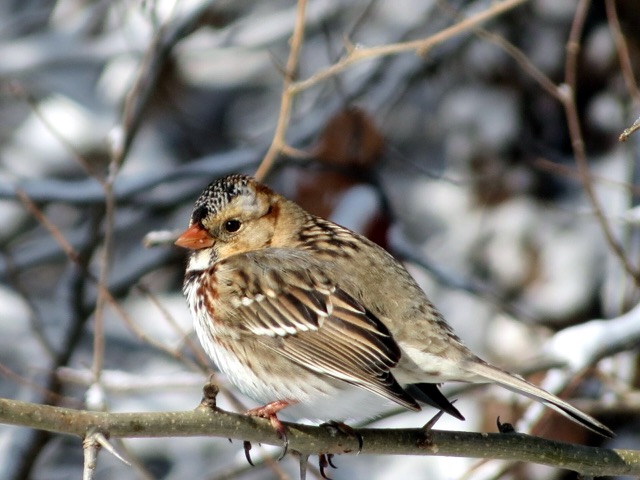
Young Harris's Sparrow
Young birds don't have the full black face. They have a few black streaks on the forehead and a "necklace" of streaks across the chest. Look for the same pink bill and white belly.
More photos
Where these facts come from
- Oklahoma Department of Wildlife Conservation field guide
- Audubon Guide to North American Birds
- When it's here: Sightings shared on iNaturalist in the 8 counties, all years.