All birds Thrushes and Allies
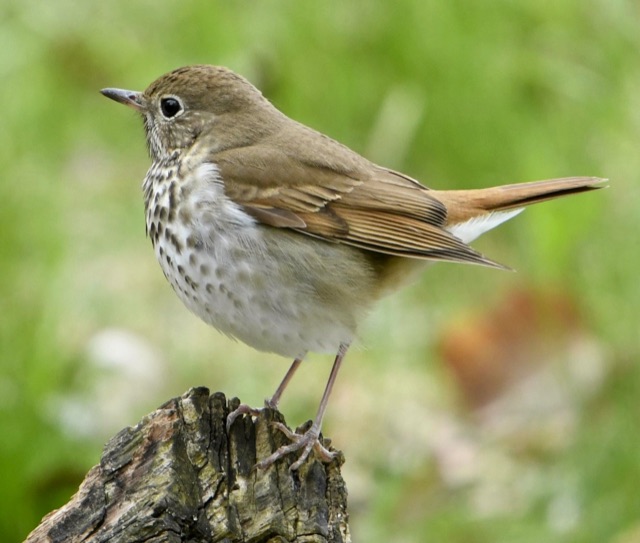

Hermit Thrush
Catharus guttatus
Here October to April.
Recorded by Christopher McPherson. CC BY-NC-SA 4.0, via xeno-canto, trimmed and volume evened out.
Look for
- A red-brown tail that's brighter than its plain brown back.
- Spots on its chest, and a white ring around each eye.
- On a perch, it may flick its wings and slowly raise and lower its tail.
A little about it
Hermit Thrushes come here for the cold months. Look for them from October to April. Of all the brown thrushes, it's the only one you're likely to see in winter.
On the ground, it picks bugs out of dead leaves and dirt, like beetles, ants, crickets, and caterpillars. It eats spiders and earthworms too. In winter, it eats lots of berries, like grapes and mistletoe berries.
Listen for a low "tuck" call. In summer, it sings in forests up north and in the mountains. Its song is a set of clear, musical bits, each one on a different note.
The female builds a bulky cup nest. In the East and North, it's often on the ground, well hidden by low plants. She usually lays 4 pale blue eggs, and the young can fly at about 12 days old.
Fun fact
If you startle a Hermit Thrush, it may not go far. It often lands on a low perch and stares right back at you.
When it's here
- January: here
- February: here
- March: here
- April: here
- May: not here
- June: not here
- July: not here
- August: not here
- September: not here
- October: here
- November: here
- December: here
Taller bars mean more sightings. Most often seen in February.
How big
6 to 7½ inches. Bigger than a sparrow, but smaller than a robin.
Where to look
Woods and parks with lots of trees. Look on the ground, where it hunts through the dead leaves.
People have spotted it at Martin Park Nature Center, Lake Thunderbird State Park.
Could it be something else?
Swainson's Thrush
Very close in size and shape. It has a bold tan ring around each eye and tan on the sides of its chest. It only passes through in spring, in April and May.
Brown Thrasher
Much bigger, about 11½ inches long, with a long tail and yellow eyes. It's rusty brown on top, with stripes down its front.
Where these facts come from
- Audubon Guide to North American Birds
- Oklahoma Department of Wildlife Conservation field guide: Brown Thrasher
- When it's here: Sightings shared on iNaturalist in the 8 counties, all years.