All birds Wrens
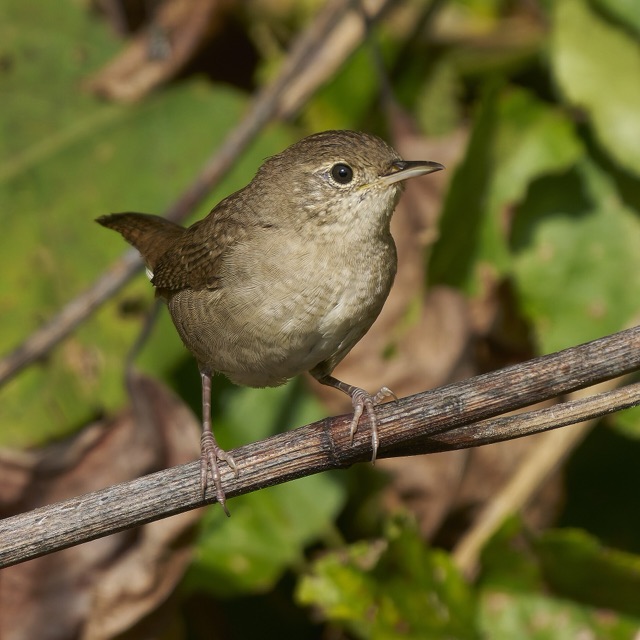

House Wren
Troglodytes aedon
Here March to July.
Recorded by Whitney Neufeld-Kaiser. CC BY-NC-SA 4.0, via xeno-canto, trimmed and volume evened out.
Look for
- Plain gray-brown, with thin bars on the wings and tail.
- Only a faint line over the eye, and a thin bill.
- A short tail that it often holds up high.
A little about it
House Wrens come here in spring and summer to raise their young, and you might see one in fall too. In 2024, scientists split the House Wren into more than one kind. The kind we see here is now called the Northern House Wren.
It's a small, busy bird that's always bouncing around. It hunts in thick plants, mostly down low, for bugs from beetles and crickets to caterpillars and moths. It eats lots of spiders too, and even a few snails.
The male sings a rich, bubbly song that goes up and then comes back down. He sings to guard his space.
The male starts nests in several holes, like old woodpecker holes or birdhouses. The female picks one and finishes it with a soft lining. She lays 6 or 7 eggs, and they often raise 2 families a year.
Fun fact
A House Wren will nest in almost any hole it can find. People have found its nests in parked cars and even in shoes.
When it's here
- January: not here
- February: not here
- March: here
- April: here
- May: here
- June: here
- July: here
- August: not here
- September: here
- October: here
- November: here
- December: here
Taller bars mean more sightings. Most often seen in April.
How big
About 4 to 5 inches. A little smaller than a sparrow.
Where to look
Yards, gardens, parks, and the edges of woods. Look low in thick bushes, and check birdhouses in spring.
People have spotted it at Lake Thunderbird State Park.
Could it be something else?
Carolina Wren
A little bigger and much more colorful. It's warm reddish brown on top and orange-tan below, with a bold white stripe over each eye.
Bewick's Wren
It has a bold white stripe over each eye, and it's pale gray underneath. Its longer tail has white spots on the corners.
Where these facts come from
- Audubon Guide to North American Birds: Northern House Wren
- When it's here: Sightings shared on iNaturalist in the 8 counties, all years.