All birds Sandpipers and Allies
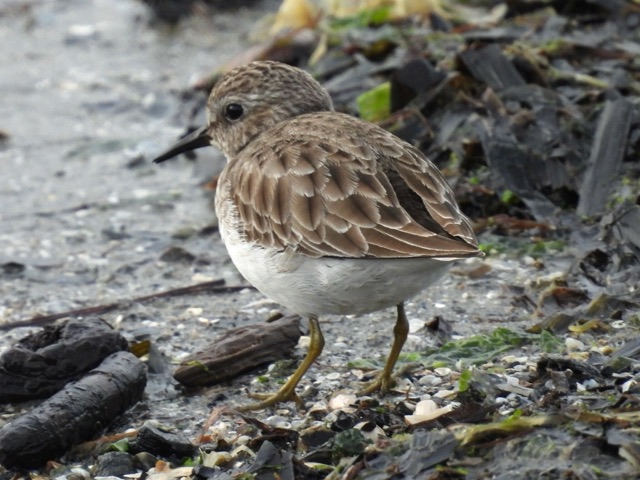
Least Sandpiper
Calidris minutilla
Passes through in April to May and again in August to November.
Recorded by Thomas G. Graves. CC BY-NC-SA 4.0, via xeno-canto, trimmed and volume evened out.
Look for
- A tiny sandpiper that's browner than the others. A brown wash runs across its chest.
- A very thin bill that bends down a little at the tip.
- Yellow or greenish legs. They can be hard to see, and they're often covered in mud.
A little about it
Least Sandpipers pass through here in spring and fall. Look for them in April and May, then again from August to November.
It walks slowly and picks tiny bits of food off the mud. Sometimes it pokes its bill down into the mud. Away from the ocean, it eats lots of bugs. It also eats small snails and seeds.
Least Sandpipers travel in small flocks. A flock will fly up, circle around, and then land again. Listen for thin, reedy calls as they go. One call sounds like a clear "treep."
They nest far up north, on the tundra and in bogs. The chicks leave the nest soon after they hatch, and they find their own food. The mom often leaves first. The dad stays until the chicks can fly, at about 14 to 16 days old.
Fun fact
This is the smallest sandpiper in the world. A grown-up weighs only about 1 ounce.
When it's here
- January: here
- February: a few
- March: not here
- April: here
- May: here
- June: not here
- July: a few
- August: here
- September: here
- October: here
- November: here
- December: a few
Taller bars mean more sightings. Most often seen in August.
How big
5 to 6 inches, with wings 10 to 11 inches across. No bigger than a sparrow.
Where to look
The muddy edges of ponds, lakes, marshes, and rivers. It also stops at flooded fields and wet meadows. Of all the sandpipers, it's the one you're most likely to find at a small pond.
People have spotted it at Lake Hefner, Arcadia Lake.
Could it be something else?
Western Sandpiper
Close in size, but it's less brown. Its legs are dark. Check the legs: yellow or green ones mean Least Sandpiper.
Spotted Sandpiper
A little bigger. It bobs the back half of its body up and down as it walks. In spring it has round black spots on its belly. It's usually alone, while Least Sandpipers often come in flocks.
Where these facts come from
- Audubon Guide to North American Birds
- When it's here: Sightings shared on iNaturalist in the 8 counties, all years.